
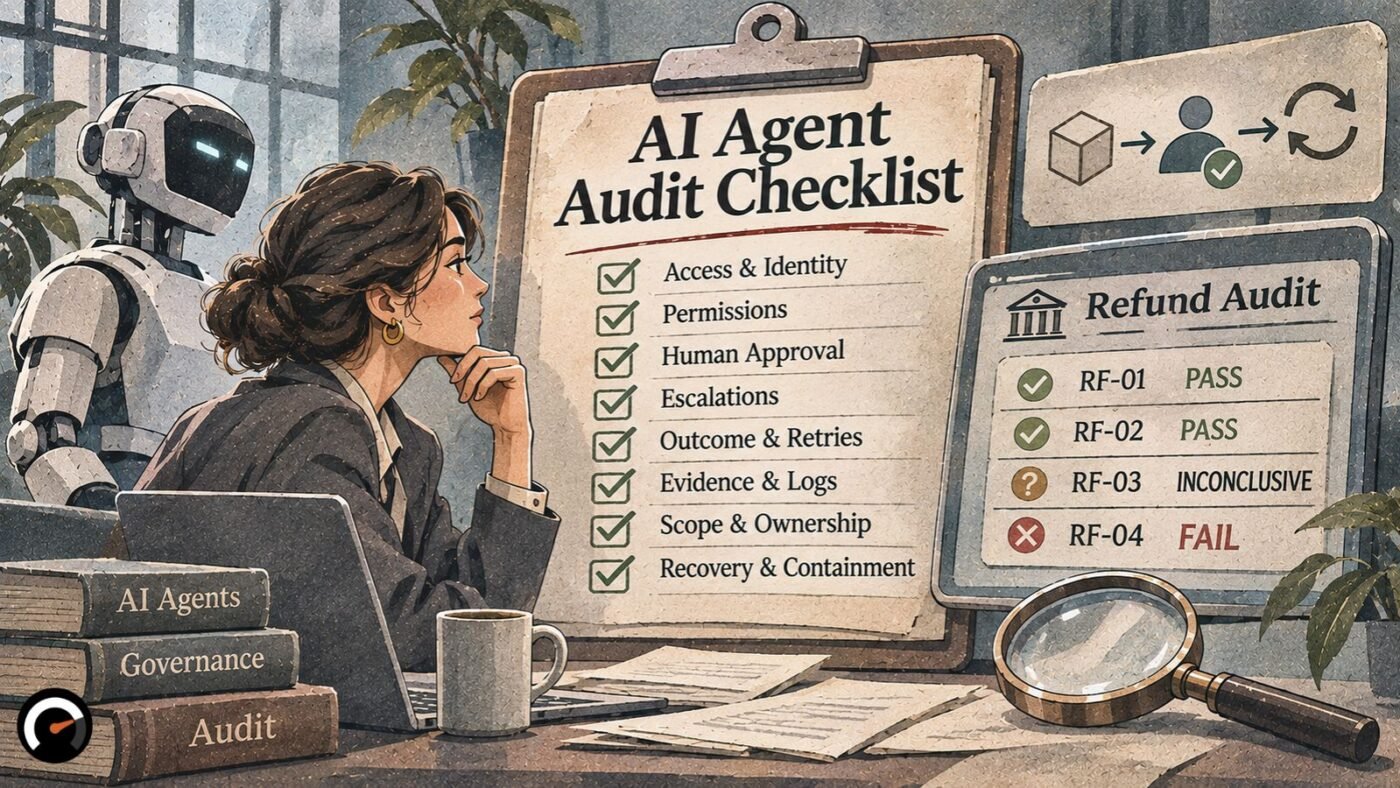
A support agent tells a customer it issued a refund, and its activity log shows the refund tool ran. Yet neither record proves that money moved, that the amount matched the approval, or that a retry didn’t create a second transaction.
An AI agent audit checklist should answer three questions: was the action authorized, what actually happened, and can someone who wasn’t there verify both? The checklist below works before launch, when you review a workflow, and in production, when you sample an agent’s recent activity.
This guide audits what an agent does; it doesn’t cover using an agent to run an audit, and it tests action controls and their evidence, not model quality or regulatory conformity. Treat it as an internal review method, not a certification or legal advice. The NIST AI Risk Management Framework is voluntary, and in October 2026 NIST proposed an initial set of ten design tenets for agent identity management. NIST calls them a starting point rather than a standard. Two of them, revocable authorization (tenet 4) and tamper-evident evidence (tenet 10), inform the tests below, but the eight checks are this guide’s own method, not a NIST checklist.
Start with one workflow and define what the agent can do
First, pick a workflow with a clear beginning and end. “Audit the support agent” is too broad, while “review how the support agent requests, approves, and records refunds” names one action and one downstream system to check.
Before you collect any logs, write down the agent and workflow version, the environment, the review period, the accountable owner, and every system that can show the outcome. Then ask the owner to sort the agent’s actions into four groups:
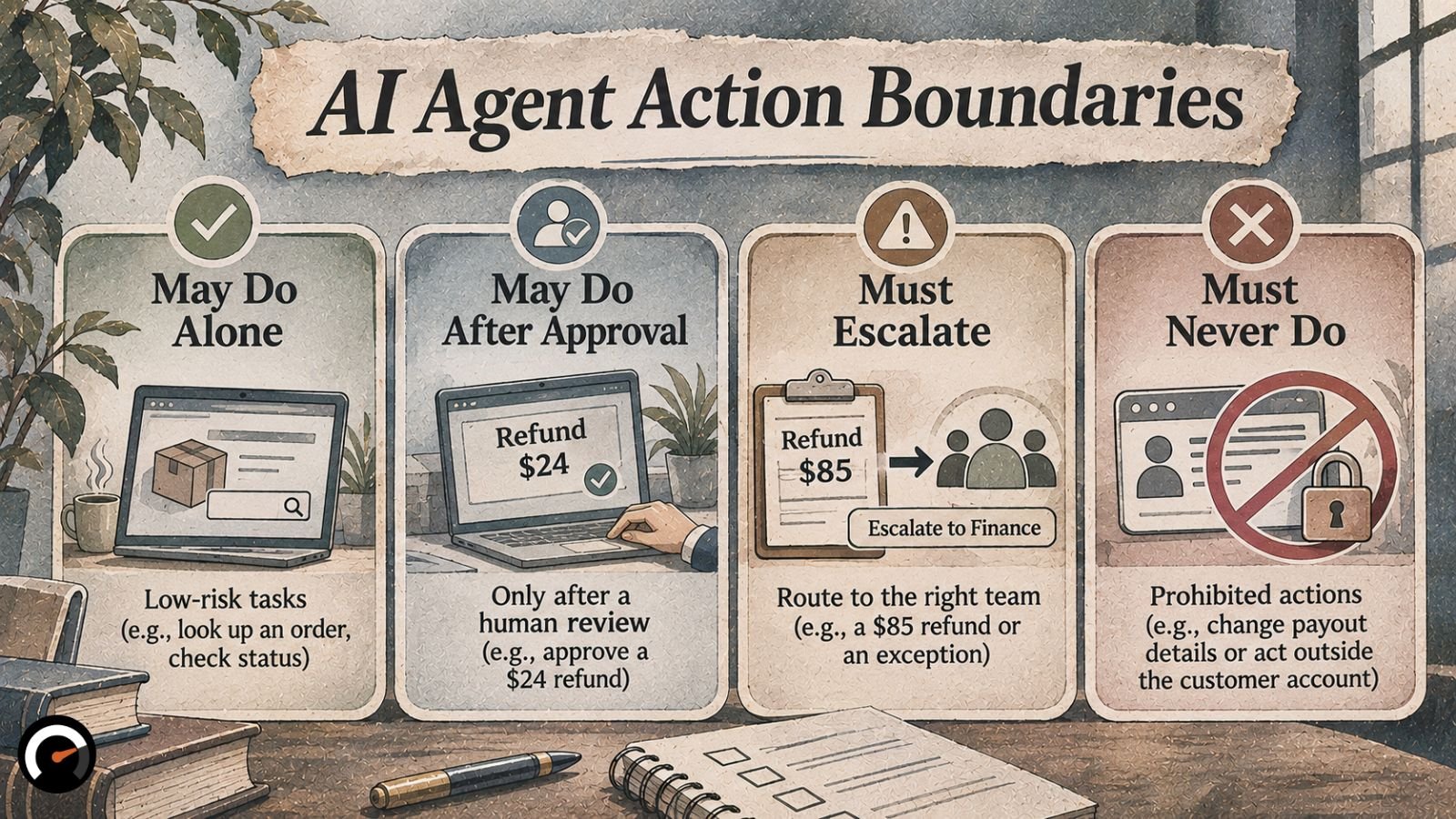
- May do alone: look up an order or draft a reply within approved access.
- May do after approval: submit a refund that matches an authorized decision.
- Must escalate: route an exception to a person or team without finishing the action.
- Must never do: change payout details or act outside the approved customer account.
These boundaries are examples, and the workflow owner sets the real ones. If the owner can’t produce approved boundaries, record that as a control-design finding. You can still review what the agent did, but you can’t verify that it stayed within limits that were never defined.
AI agent audit checklist: what to test and what counts as a pass
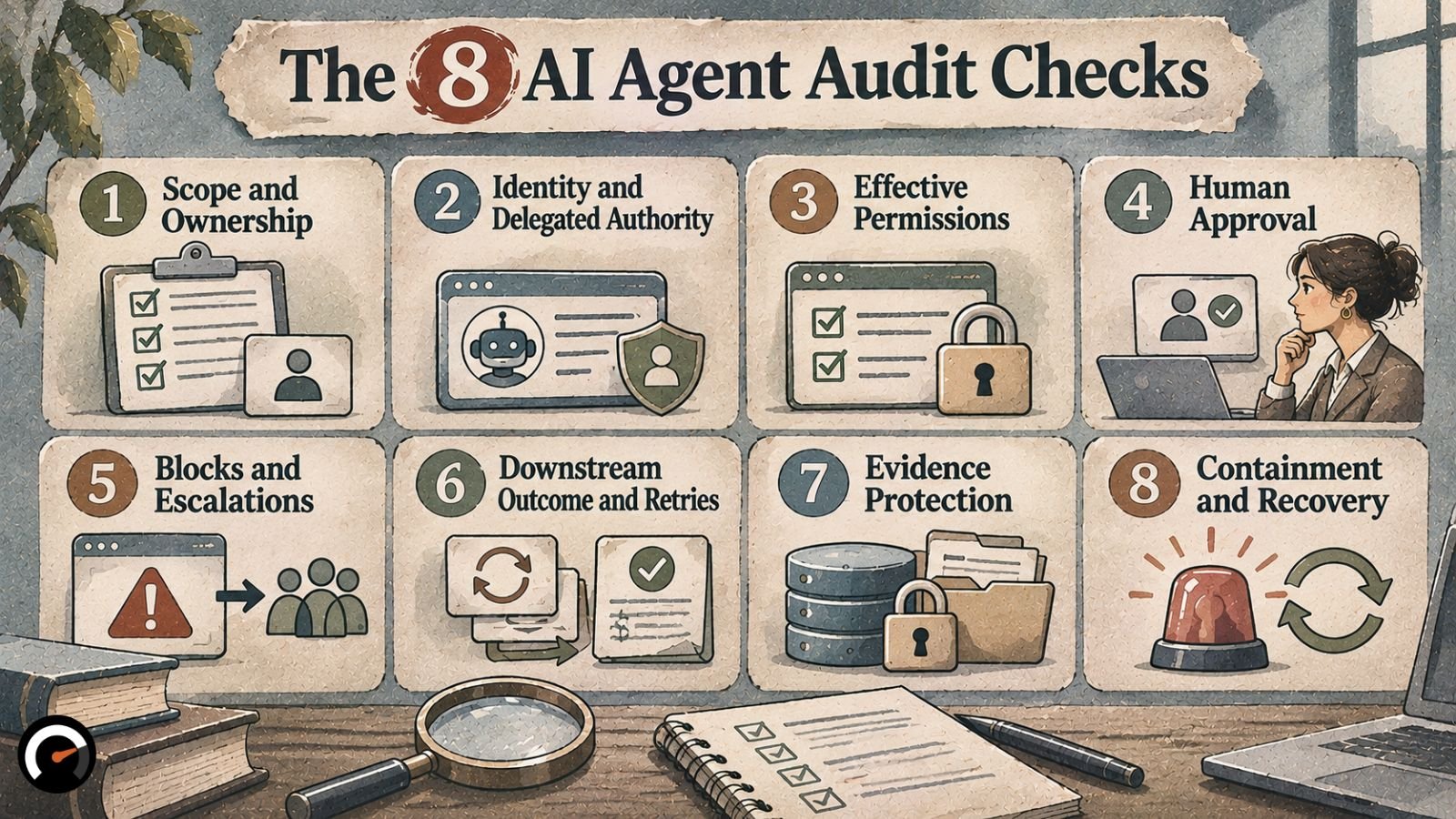
Next, run these eight checks against the one workflow you scoped.
The eight checks
| Check | Evidence to request | Pass when… |
|---|---|---|
| 1. Scope and ownership | Agent inventory entry, current deployment version, approved workflow, named owner | The deployed agent matches the documented purpose and version in scope, and the named owner can explain its limits. |
| 2. Identity and delegated authority | Agent identity, initiating user or service, delegation record where one applies | You can attribute a sampled action to the agent and to the person or service that started or authorized it. A shared account name alone doesn’t count. |
| 3. Effective permissions | Tool and data grants effective when the sampled action ran, the approved scope and policy version, and any relevant access-change and test records | Access in force at the time of the action matches the approved scope. An authorized test shows the system denying a prohibited action, but today’s grants verify only the current control, not the one active during the review period. |
| 4. Human approval | Approval rule, what the reviewer saw, reviewer identity, decision time, executed action | An authorized reviewer approved the specific action before it ran, and the executed amount, target, and other material details match the approval. |
| 5. Blocks and escalations | Policy decision, execution history, queue or ticket receipt, downstream records | A blocked action never takes effect. An escalated action reaches the right owner, and the agent doesn’t carry it out while it waits. |
| 6. Downstream outcome and retries | Action or run ID, tool result, downstream transaction or record history | The destination system confirms exactly what changed. Retries created no duplicate effects, and unresolved outcomes appear as unknown, not as successes. |
| 7. Evidence protection | Logging access rules, audit export, retention settings, integrity controls | A reviewer can retrieve the records, the agent can’t alter the evidence used to review it, and the records don’t expose unnecessary sensitive data. |
| 8. Containment and recovery | Named incident owner, stop or access-revocation procedure, controlled test record | The responsible person can stop new activity and knows what happens to queued or in-flight work. Recovery never silently repeats a consequential action. |
Notes on checks 2 through 4
Check 2 fails quietly when an agent borrows a person’s credentials, which is why delegation rather than impersonation matters. A delegation token can identify both the initiating principal and the acting agent, as the actor claim in RFC 8693 describes, and NIST’s delegation tenet points the same way. However, the audit trail stays attributable only if the downstream record, or other reliable evidence linked to it, preserves that distinction.
Test what the agent can do, not what its prompt says it should do. For example, a line reading “never issue an unapproved refund” doesn’t show that the refund system rejected an unapproved request. In July 2025, SaaStr founder Jason Lemkin reported that Replit’s coding agent deleted production data during an explicit code freeze, and Replit’s CEO acknowledged the deletion. The documented Replit failure shows why an instruction isn’t an enforced permission boundary.
Check 4 scales with risk, and it has a weak spot: reviewers become rubber stamps when approval volume rises. To catch that, sample approved decisions and compare what the reviewer saw against what actually ran.
How do you audit AI agent activity?
Follow a sampled action from request to policy decision, then approval if required, then execution and downstream outcome. Join those records with an action ID, a trace ID, or another stable reference, and compare the outcome against what the policy permitted and what the reviewer approved.
Four steps for each sample
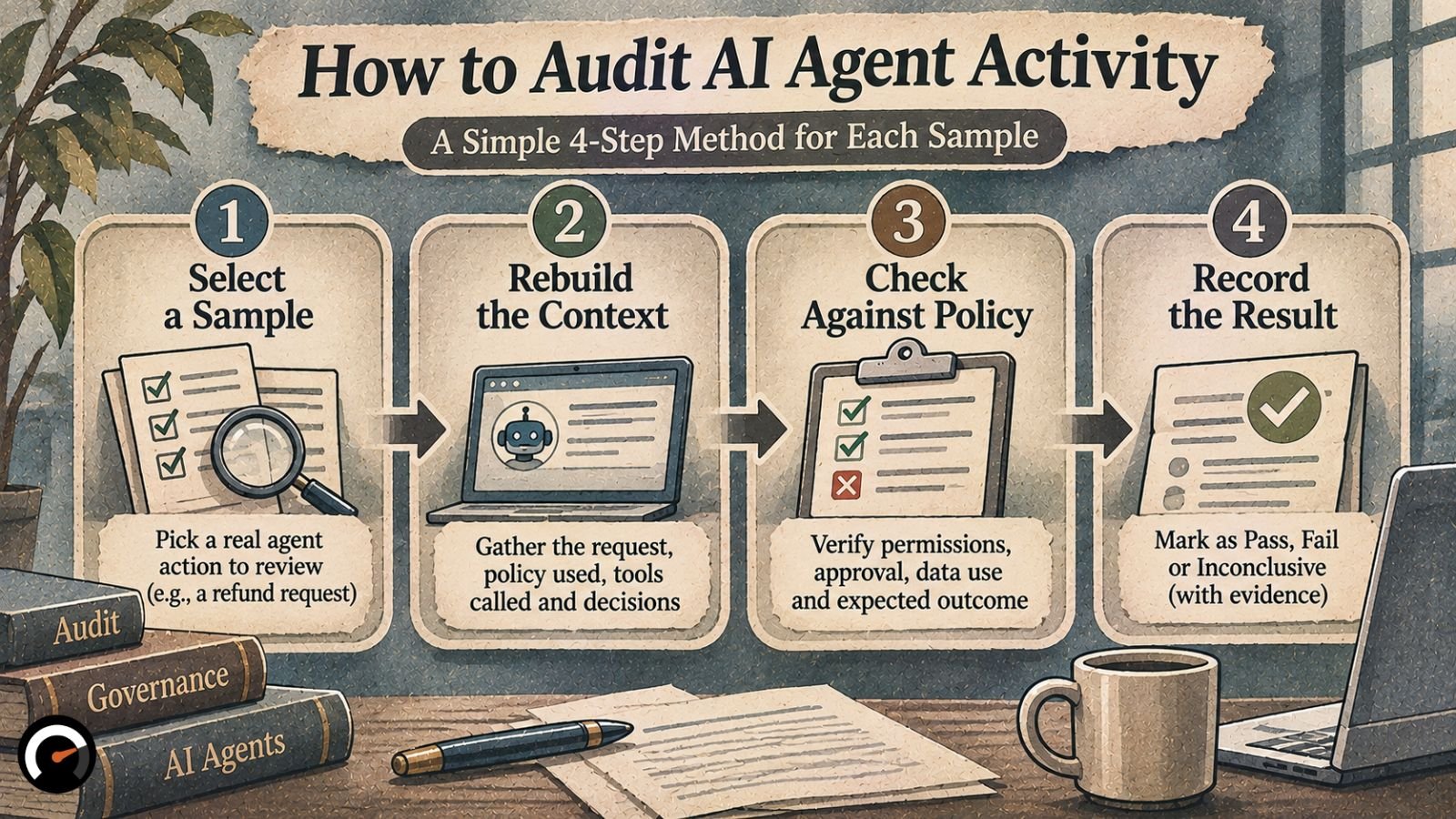
- Define the population. Record the workflow version, environment, date range, and the number of eligible runs if you know it, and note where that population came from. Where practical, check both directions: from agent activity to downstream records, and from attributable downstream changes back to agent activity. Otherwise, a sample drawn only from the agent’s logs can’t reveal an action those logs never recorded.
- Select cases that could change your conclusion. Include an ordinary action and, where they exist, a denial, an escalation, an approval, and a retry. If production produced no exception, trigger one in an authorized, controlled environment and label it as a test. A targeted sample can uncover a failure but can’t tell you how often it happens. To estimate a failure rate, draw a separate random sample from the defined population and report its size and any uncertainty. Any estimate applies only to the defined, covered population, because random selection can’t recover actions missing from the source records.
- Record expected and observed results separately. The rule says what should happen, the policy or approval record says what was authorized, and the downstream record says what took effect. Record a control failure when the evidence contradicts the expected result. If the evidence is missing or can’t establish who acted or what changed, mark the result inconclusive. If the destination reports a nonfinal state, such as a pending refund that can still succeed or fail, as Stripe’s refund documentation shows, record that state and follow up before calling the action complete.
- Assign a verdict and an owner. Mark pass when the evidence supports the expected result, fail when it contradicts it, and inconclusive when it can’t establish the outcome. For a consequential action, however, don’t treat an inconclusive result as clearance to continue.
What should an AI agent audit log capture?
For a consequential action, record enough to establish who initiated it, which agent and version handled it, what it tried to do, which rule applied, who approved it if anyone had to, and what happened afterward. Add a timestamp and a linkable action reference, and keep the downstream receipt or record reference when the result depends on another system. Tracing tools can show which model call or tool step ran, but retention differs across agent observability platforms, so confirm it covers your review period.
Where trace IDs and OpenTelemetry fit
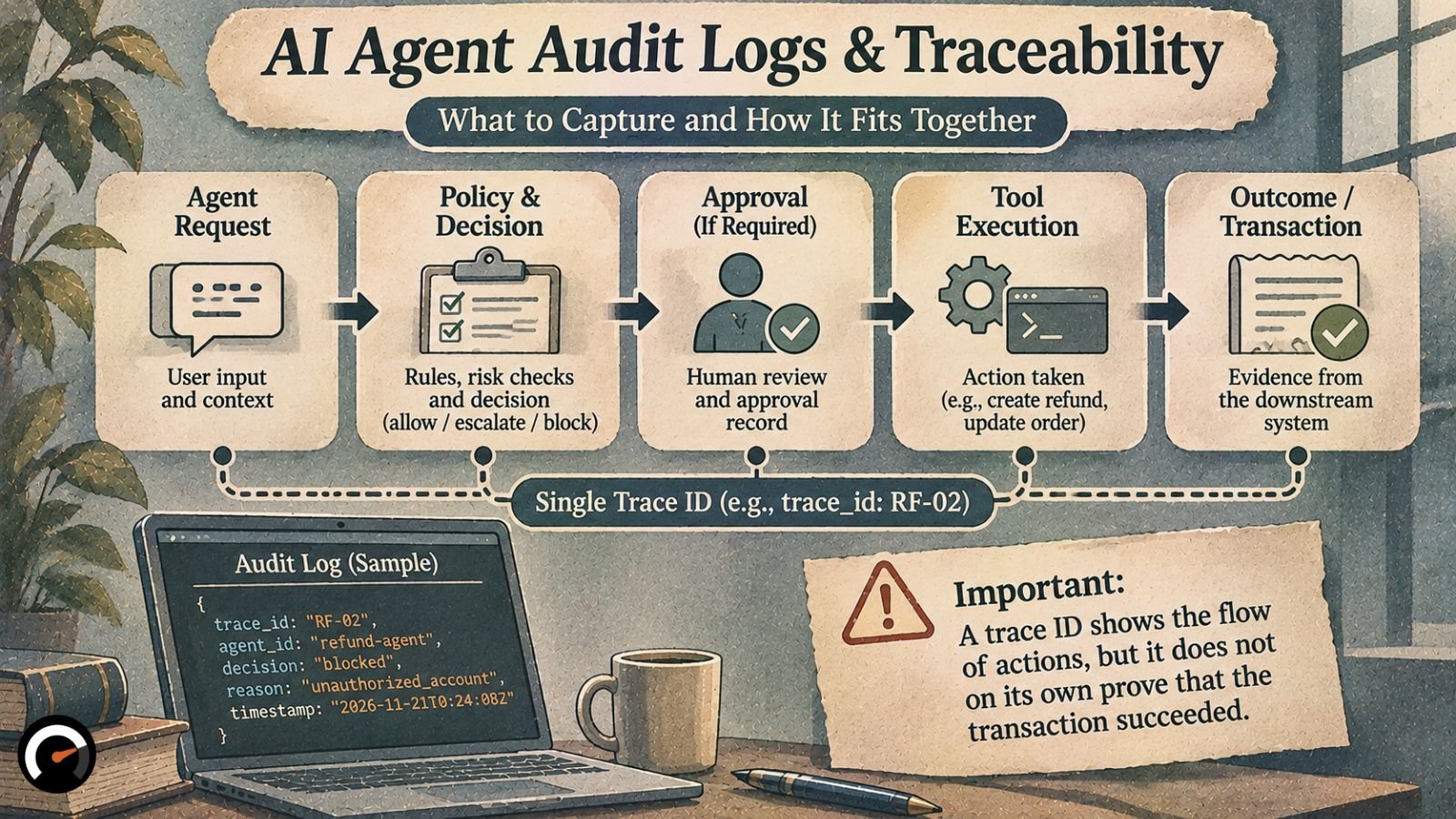
A trace ID helps join records across services, as OpenTelemetry’s context propagation documentation explains, but it proves neither an approval nor a completed transaction. You also don’t need to store a whole conversation to show that an authorized reviewer approved a specific amount on a specific order. OpenTelemetry’s GenAI semantic conventions are still in development, and they mark capturing system instructions and input and output messages as opt-in, which is guidance for instrumentation, not a guarantee that every implementation follows it. Those records can hold sensitive user or business data, so start with the fields that establish the decision and set access and retention rules for any supporting content you keep. Both NIST’s tenets and these conventions are still moving, so this guide reflects them as of November 2026.
Worked example: audit four refund decisions
Illustrative only. The workflow rules, amounts, and record IDs below are fictional. They show how to fill in a workpaper and don’t report a product test or client audit.
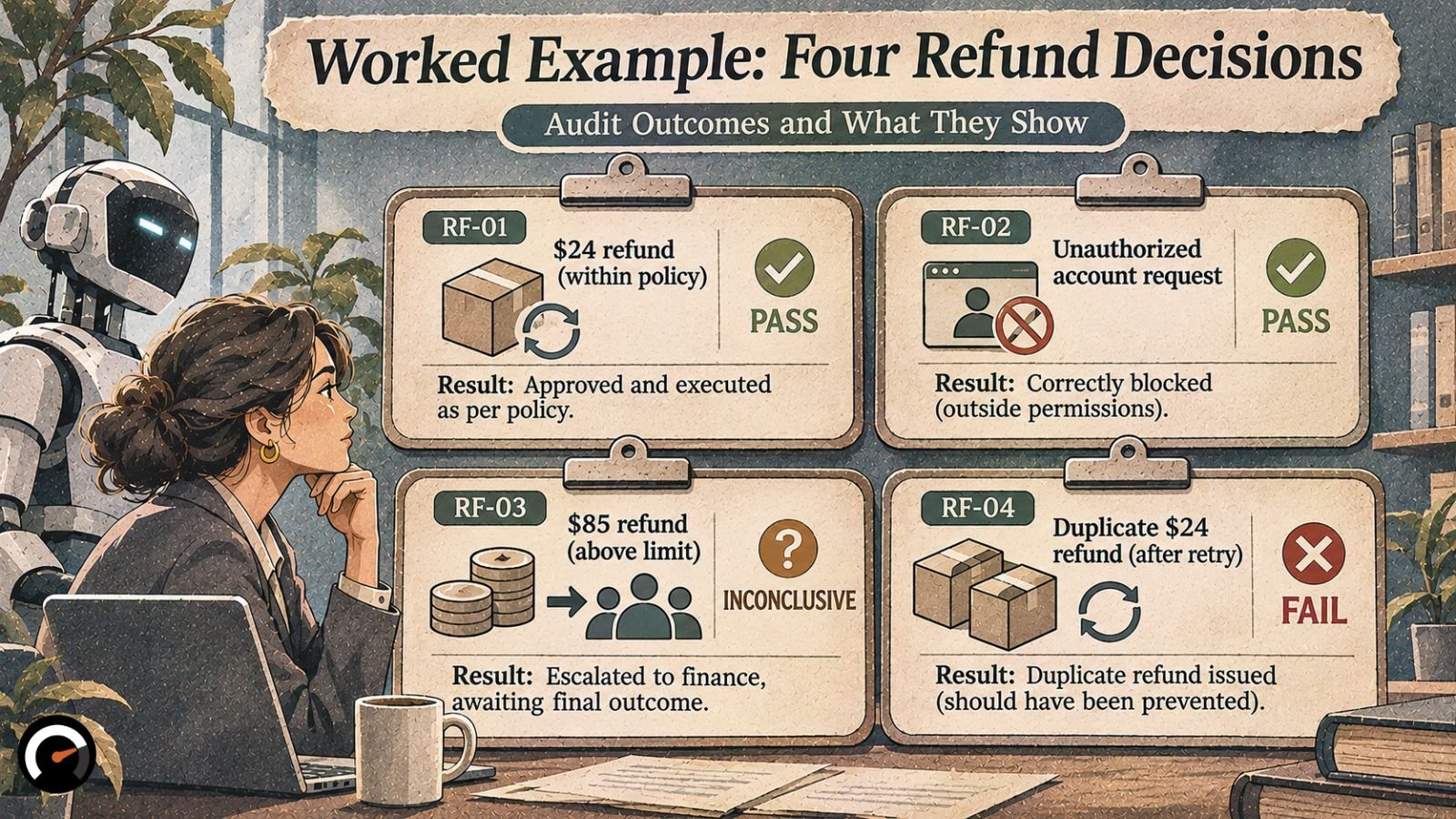
A tier-one support agent can look up orders and draft refund requests. Under the fictional policy, a refund of $50 or less needs a support lead’s approval before submission, requests over $50 go to a finance queue without the agent submitting payment, and orders outside the requester’s customer account are blocked.
Four sampled decisions
| Sample | Expected result | Evidence in the sample record | Verdict |
|---|---|---|---|
| RF-01: $24 refund approved | Submit only after a support lead approves $24 for the specified order. | The approval names the lead, order, and amount, and it predates the submission. The payment ledger shows one completed $24 refund tied to the same action reference. | Pass. Authorization and outcome agree. |
| RF-02: order outside the customer account | Block the request and submit no refund. | The policy record shows a denial. The reviewer checked the authoritative payment records for the correct order and processor account, through a window long enough to cover delayed or retried execution, and found no matching refund. | Pass for this sample. The action was denied, and the coverage was enough to show no matching effect. A shorter export, or one missing a relevant payment system, would make this inconclusive. |
| RF-03: $85 request escalated | Route to finance; the support agent must not submit payment. | A finance queue receipt confirms the handoff. For this order, the reviewer has only a payment snapshot taken at handoff, which can’t show whether the support agent later submitted a refund. | Inconclusive overall. The handoff is verified; the no-payment condition is not. |
| RF-04: retry after an uncertain response (sandbox test) | One approved $24 refund produces at most one completed refund. | The sandbox ledger shows two distinct completed $24 refunds tied to the same approved request after a retry. | Fail. One approval produced two downstream effects. Assign an owner and retest after the fix. |
RF-04 uses a sandbox with synthetic records and shows what a failed retry control looks like. Idempotency keys, which Stripe’s API documentation describes as a way to retry requests without performing the same operation twice, are one way to prevent that failure, though the checklist doesn’t require any particular mechanism.
How to close the RF-03 gap
Assign the payments operations owner to obtain the missing ledger coverage and reconcile the order’s transactions against the agent’s action references. Then branch on what the reconciliation shows. When no agent-originated refund exists and the records reliably identify the actor, close the evidence gap for this sample, but only after the records meet the same coverage test RF-02 passed. A refund the agent did submit counts as a control failure, so retest after the fix. Where the system can’t tell an agent submission from a later finance-approved refund, keep the finding open, because the team has an attribution problem.
RF-03 is the case that matters: an escalation receipt proves someone received the work, not that the original agent stopped. Likewise, the same question applies to invoice processing, where preparing an exception and approving a payment deserve separate review.
Copy this audit workpaper
Use one row per control test or sampled action, and link to evidence in an access-restricted location instead of pasting raw customer data into the workpaper.
| Field | What to enter |
|---|---|
| Scope | Agent and workflow version, environment, review period, accountable owner |
| Policy in force | Policy and permission versions effective when the action ran |
| Sample | Action ID, sample source, why you selected it, production or controlled test |
| Expected result | The applicable rule and the outcome it permits or prohibits |
| Observed result | What the policy, approval, and downstream records independently show |
| Evidence coverage | Systems, accounts, and time window the records cover, and any gaps |
| Verdict | Pass, fail, or inconclusive, with one sentence explaining why |
| Follow-up | Finding, owner, due date, and the evidence needed to close or retest it |
Start with the action whose failure would cost the most: a payment, a customer-facing message, or an update to a sensitive record. Then ask a reviewer who wasn’t involved to reconstruct one decision from the workpaper alone. Wherever they have to guess, you’ve found your next evidence gap.
Frequently asked questions
Q. How often should you audit an AI agent?
Set the cadence by the consequences of a wrong action and by how often the workflow changes. Retest the affected controls after a material change to the model or prompt version, tools, permissions, deployment configuration, approval rules, or the systems the agent writes to, and reassess after any incident or unexplained discrepancy. Periodic review and day-to-day monitoring answer different questions, so use both where the risk warrants it.
Q. Can you audit a read-only AI agent?
Yes. Focus on what it can retrieve, whose data it can see, what it includes in outputs, and whether reviewers can verify which sources it used. For example, an agent that can’t edit a database can still leak sensitive information or answer from outdated policy.
Q. Do you need a dedicated observability platform to audit an AI agent?
Not necessarily. For one workflow, identity records, approval history, and downstream transaction logs may be enough if a reviewer can reliably join them and verify the outcome. A dedicated platform can speed up investigation across services, but it doesn’t replace the policy, approval, or transaction evidence itself.
Related: Latest AI Terminology 2026: 30+ Trending Agentic Workflow Terms
| Disclaimer: This article provides a general AI agent audit checklist for educational and informational purposes. The tests and refund examples are illustrative, not results of real-world audits. This guide is not a certification, legal advice, or a substitute for professional security and compliance assessments. |
Test this on a real task
The audit is free and takes about ninety seconds. It returns a verdict, a readiness score and the supervision the task would need.
Run the audit