

AI is not replacing real estate agents wholesale, based on the evidence available in October 2026. It is taking over a growing share of agents’ tasks. The open question is whether AI lets fewer agents handle the same number of transactions. Nobody has measured that yet.
This article covers U.S. jobs data, surveys, licensing rules, and commission changes, none of which apply directly to other countries. Sourced facts and editorial analysis are kept separate, and the analysis is labeled.
Key numbers at a glance
- 2%: projected growth in U.S. broker and sales agent jobs from 2025 to 2035 (BLS)
- 88% of buyers and 91% of sellers used an agent in NAR’s 2025 survey, a record for sellers
- 5%: share of homes sold by owner (FSBO), a record low
- 55% of Realtors say AI has had a positive impact on their business, up from 50% in 2025 (NAR)
- 9% of surveyed agents mainly use AI in agentic tools that can take multi-step actions (Inman Intel, April 2026)
Will AI Replace Real Estate Agents? The Short Answer
The evidence doesn’t show AI replacing real estate agents, and it doesn’t show AI shrinking agent headcount either. Agent use reached a record high in NAR’s 2025 survey, and federal projections point to modest job growth through 2035.
Neither data source measures AI’s causal effect on employment. They describe projections, adoption, and how many buyers and sellers used agents.
The risk worth watching is displacement by productivity. If AI-assisted agents each close more deals, brokerages could need fewer of them. “AI replaces the agent” and “AI shrinks the headcount” are different claims, and the second is the more plausible one.
What the Latest Data Shows About Agent Jobs and AI Use
| Measure | Latest figure | What it can’t tell you |
|---|---|---|
| BLS employment | 530,600 jobs in 2025: 103,500 brokers and 427,000 sales agents | Employment estimates for the occupation, not AI’s effect on it |
| BLS outlook | 2% growth to 2035, a net gain of 8,300 jobs, about 40,400 openings a year | Most openings replace people who leave; BLS doesn’t model AI separately |
| Agent use (NAR, 2025) | 88% of buyers, 91% of sellers, 5% FSBO | Share of transactions using agents, not demand for agent labor. NAR is a trade group. |
| AI adoption (Delta Media) | 97% of brokerage leaders say their agents use AI, up from 80% in 2024 | Delta Media sells real estate technology. The survey measures use, not productivity. |
| AI impact (NAR, 2026) | 55% positive (16% significantly), 34% no impact, 11% negative | Self-reported by 1,165 respondents out of 73,718 invited |
The BLS Occupational Outlook Handbook reports median wages of $73,220 for brokers and $52,830 for sales agents in May 2025. Those figures exclude self-employed workers, who make up roughly half of the occupation.
The NAR 2026 Technology Report shows AI moving into daily work. Daily use reached 23% of Realtors. Positive impact rose from 50% to 55%, while the share reporting a negative impact rose from 4% to 11%, Real Estate News reported.
The top uses remain content tasks: listing descriptions (75%), social media posts (56%), and emails and follow-ups (52%). None of these surveys measures whether AI changed how many agents a brokerage employs.
The Four Levels of AI Replacement in Real Estate
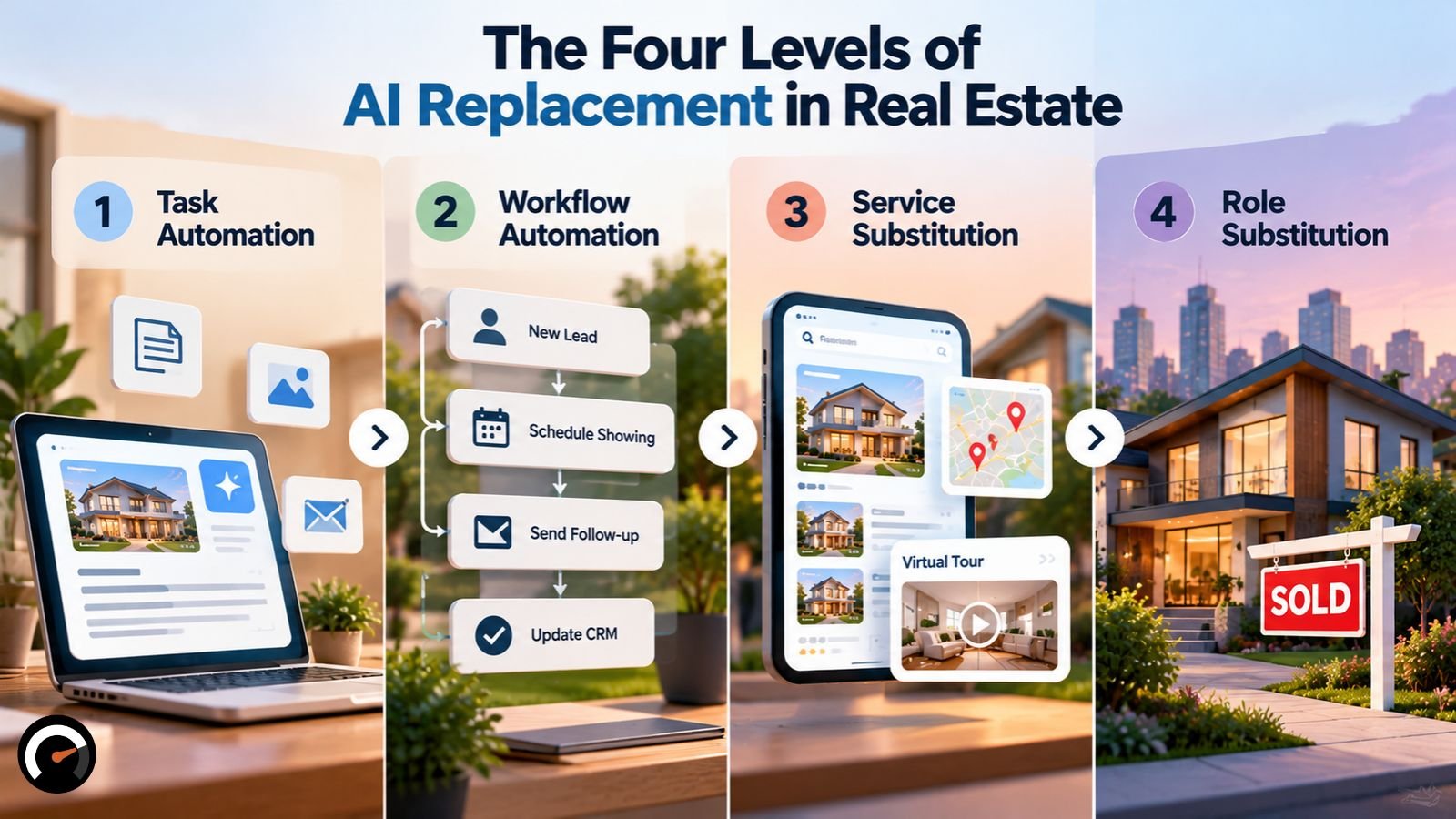
The phrase “AI replacing agents” mixes up four different things. Each level has a different measure and a different amount of evidence behind it.
| Level | What AI does | Real estate example | What to measure | Evidence so far |
|---|---|---|---|---|
| 1. Task automation | Completes one repeatable task | Listing copy, email drafts | Minutes saved per task | Widespread |
| 2. Workflow automation | Runs several connected steps | Lead routing, CRM updates, follow-up | Human hours per qualified lead | Early |
| 3. Service substitution | Performs work sold as an agent service | AI-assisted buying or self-service selling | Cost, completion rate, error rate | Small and mostly self-reported |
| 4. Role substitution | Reduces the number of human positions | A smaller team handles the same volume | Transactions per agent, staffing | Not measured |
Level 1 is common. Most agents now use AI to write.
Level 2 is starting. An Inman Intel survey in April 2026 found that 75% of respondents mainly used AI through chat. Only 9% mainly worked in agentic or integrated tools that can access files and take multi-step actions. That difference matters because AI agents work in loops: they pick a step, use a tool, check the result, and decide what comes next. Platforms are building for this level. In October 2026, Realtor.com added RealAssist AI for agents, which sets up clients, sends daily client summaries, and suggests next steps. Agents approve every action it takes.
Levels 3 and 4 are where jobs would actually change. The cases later in this article show Level 3 in small numbers. No source measures Level 4.
Analysis: AI that drafts a listing doesn’t threaten headcount. AI that also updates the CRM, follows up with leads, and summarizes disclosure packets is a more credible path to fewer agent hours per deal. The trade-offs between augmentation versus full automation decide how far each task can move.
Which Real Estate Tasks Can AI Handle Today?

Analysis: AI handles information work well and assists with advisory work. Trusting it with full responsibility for a complex transaction is the hardest step, because automating a task is different from replacing the person accountable for it.
| Tier | Tasks | Who owns the result |
|---|---|---|
| Mostly automatable | Listing descriptions, first-pass home search, email drafts, scheduling, document extraction | AI drafts; a person checks |
| AI-assisted | Market comparisons, lead qualification, contract review support, offer preparation | A licensed professional |
| Hardest to delegate fully | Resolving unusual problems, managing conflicting interests, carrying professional liability | A licensed professional |
The stakes rise as a task moves closer to the client. Listing copy is the lowest-risk starting point, though an AI listing creation audit still weighs how repeatable the work is against the cost of a wrong detail. Automating real estate lead follow-up carries higher stakes because it reaches prospects directly. Messages that advise a client sit higher still, because client communications carry liability.
“AI can’t negotiate” overstates the case. AI can help prepare offers and analyze counteroffers. What lacks independent evidence is AI running a full transaction on its own and taking responsibility for the outcome.
What Net Productivity Gains Depend On
Time saved by AI isn’t the same as labor saved. Net productivity equals time saved minus the time spent checking, correcting, integrating, and managing compliance.
Agents expect errors and use AI anyway. In Inman Intel’s April 2026 survey, 49% of respondents expected AI to frequently produce factual errors but kept using it. The same survey found that 28% of agents said AI made them significantly more productive, up from 11% in December 2024.
Analysis: Every AI output that reaches a client needs review. Real estate isn’t unusual here. Research on knowledge work automation results shows large gains in controlled experiments but a messier picture across whole workforces. As long as review stays necessary, the headcount effect of AI depends on how fast checking gets cheaper, not just how fast drafting does.
What Could AI Mean for Real Estate Jobs by 2030?
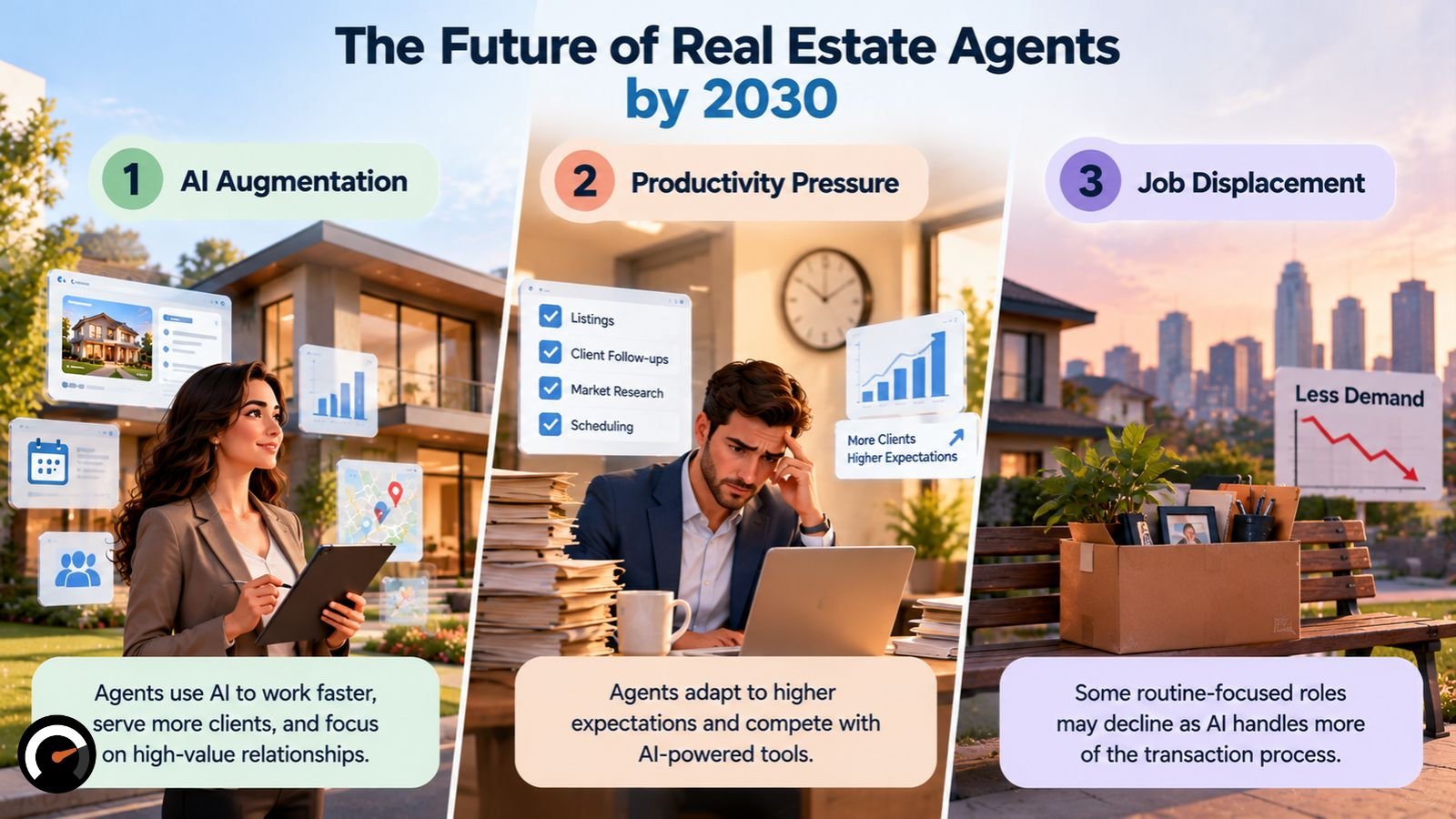
No credible forecast puts a number on AI’s effect on agent jobs by 2030. The BLS projection runs to 2035, but it is not an AI forecast. Three scenarios cover the plausible range:
- Augmentation. Agents finish routine work faster, but transaction volume and staffing stay broadly stable.
- Productivity pressure. Each agent closes more deals, and brokerages reduce hiring or consolidate teams.
- Displacement. AI-enabled services handle most of the buyer and seller workflow. Humans remain for regulated duties, exceptions, and complex deals.
The data will tell these scenarios apart. Watch deal volume per agent, brokerage staffing, broker-to-agent ratios, agent compensation, the share of licensees closing deals, and independently verified agent-free transactions. None of these currently points clearly to scenario 3.
How BLS Employment and NAR Membership Differ
BLS and NAR count different populations, so their numbers shouldn’t be compared directly.
BLS estimates occupational employment: 530,600 brokers and sales agents in 2025.
NAR counts association members. Its 2026 Member Profile covered 1,438,569 members, a group that includes part-time and less active licensees who pay dues.
NAR budgeted for membership to fall to 1.2 million in 2026, and it attributed that forecast to market conditions. Attrition has run behind NAR’s own expectations. The group budgeted for 1.4 million dues-paying members in 2025 and had 1.49 million, Inman reported. How much AI contributes to membership changes is unmeasured.
Are AI Home-Search Tools Replacing Agents?

Not so far. Consumer AI search tools change how buyers find homes and how leads reach agents. The major portals still route users back to agents.
- Zillow launched an app in ChatGPT in October 2025. In March 2026, it launched Zillow AI mode, which lets users search through conversation, then book tours or connect with an agent. A Gemini integration followed in July 2026.
- Redfin launched its ChatGPT app in February 2026.
- Realtor.com launched a consumer version of RealAssist AI, built with Google’s Gemini, in June 2026.
Zillow says agents who use at least one of its products touch an estimated 80% of U.S. residential transactions. Its business depends on agents. Routing users back to agents is a strategic choice, and it could change.
How to judge whether an AI real estate tool threatens agent jobs
Ask four questions about any new tool:
- Which steps does it complete without a human?
- Where does a licensed person enter the process?
- Does it let one agent close more deals, or only generate leads?
- Who is accountable when its output is wrong?
A chatbot that creates inquiries, with a human handling every qualified buyer, changes lead generation. A system that also qualifies buyers, schedules tours, collects documents, and drafts contracts could change staffing.
Can You Buy or Sell a Home Without an Agent Using AI?
Yes, in small, early cases, most backed only by the companies’ own claims. Every example below still involves humans: staff agents, lawyers, or transaction brokers.
| Company or case | What it does | Where humans remain | Evidence quality |
|---|---|---|---|
| reAlpha (Claire) | Launched in April 2024 as a zero-commission AI buyer’s agent | In-house licensed agents | Company announcement |
| TurboHome | AI-powered brokerage launched in late 2024 | Charges buyers a flat fee and rebates the rest of the seller-paid commission; agents on staff | Trade press |
| Homa | Announced in December 2025 the first U.S. purchases by self-representing buyers using its AI platform, in Florida | Optional flat-fee transaction broker | Company press release |
| AiTrado | Claimed its first fully end-to-end transaction without a traditional agent in March 2026, in Minneapolis | Not detailed | Company press release |
| Stuart Thompson (NYT) | Sold his Hudson Valley home with help from AI chatbots | Closing lawyer | Personal account |
| Robert Levine (Florida) | Sold his Cooper City home for $954,800 with help from ChatGPT | Closing lawyer; a buyer’s agent on the other side | Personal account and press coverage |
Homa and AiTrado both call themselves first. Treat “first” and “end-to-end” claims as marketing until independent volume or outcome data appears.
What the two seller cases show, and what they don’t
Thompson wrote about his experiment in detail. He sold for $605,000. By his math, that put as much cash in his pocket as a $643,000 sale with normal commissions.
His case also exposes AI’s weak spot. When he objected to paying a buyer’s agent, the chatbot suggested stating in the listing that he offered 0%. That suggestion ran against the rules adopted after NAR’s 2024 settlement.
Levine’s sale closed in under a week, and he used an MLS listing service and a closing lawyer alongside AI. Coverage of the sale reported that some negotiation points he took from ChatGPT didn’t apply under Florida law. Realtor.com later reported that a local agent reviewed 31 comparable sales. She found his price per square foot above the area average, but questioned whether wider marketing could have drawn a bidding war.
These cases show that motivated sellers can use AI to handle some work traditionally done by agents. They don’t show whether the approach performs as well as agent representation across markets, property types, or less experienced sellers.
AI-Assisted FSBO vs. Traditional Representation: Cost Comparison

AI changes who does the work, not every cost line. Use this framework to compare options. Actual fees vary by market and are negotiable.
| Cost area | Traditional representation | AI-assisted FSBO |
|---|---|---|
| Listing-side service | Negotiated listing fee | Your own time, or a flat-fee service |
| Buyer-agent compensation | Negotiated separately | Still possible, depending on the offer |
| MLS access and marketing | Often included in the listing package | May require a paid flat-fee MLS service |
| Legal and closing services | Varies by transaction and state | Still commonly needed |
| Time and risk | Much of the work delegated | Most work and risk stay with the seller |
The NAR price gap needs careful reading. In NAR’s 2025 data, FSBO homes sold at a median of $360,000 versus $425,000 for agent-assisted homes. That $65,000 gap doesn’t measure the value an agent adds.
FSBO sales differ from open-market sales. The top reason sellers went FSBO, at 30%, was selling to a friend, relative, or neighbor. Among sellers who already knew their buyer, 38% sold the home themselves. Among sellers who didn’t, 96% used an agent. Property type and local market conditions also differ between the two groups.
AI-assisted selling or buying fits best when:
- You already know the other party
- The property is standard and easy to price
- You’ll still hire a closing lawyer or title company
A human agent matters more when:
- The property is unusual or hard to price
- The timeline is tight
- Disclosure obligations are complex
- Multiple parties, contingencies, or linked sales are involved
Check your state’s disclosure and contract rules before going solo.
What AI Gets Wrong in Real Estate
AI errors in real estate fall into three groups. Keeping them separate prevents overstating any one risk.
Demonstrated incidents: both seller cases above. Thompson’s chatbot gave advice that conflicted with post-settlement rules, and Levine relied on negotiation points that didn’t apply in his state.
Reported concerns: frequent factual errors, which most agents expect, and misleading AI-altered listing images.
Foreseeable risks (no reliable incidence data):
- Outdated property information in AI-written listings
- Fair housing problems in descriptions, recommendations, or lead screening. Realtor.com says it built fair housing guardrails into RealAssist, a sign the industry treats this as a real concern.
- Inaccurate contract or inspection summaries
- Exposure of client financial or identity data entered into consumer AI tools
- Missed disclosure, financing, or title issues
Does Licensing Protect Real Estate Agents’ Jobs?
Licensing protects the broker role, not necessarily today’s headcount. Every state requires people performing regulated brokerage activities to be licensed, and sales agents must work under a broker. Exact rules and exemptions vary by state.
AI-first brokerages meet those rules by putting licensed people behind the software, as reAlpha and TurboHome do. Licensing doesn’t stop one supervising broker from using AI to serve more clients.
Regulation is also adding duties for licensed agents. California’s AB 723 took effect on January 1, 2026. It requires agents to disclose digitally altered listing images, including AI edits, and to provide access to the originals. Willful violations can be prosecuted as a misdemeanor under California’s real estate law. Other states and MLSs set their own disclosure rules.
How Commission Rules and AI Interact
Since August 17, 2024, agents working with buyers must sign written agreements before touring MLS-listed homes. Offers of buyer-agent compensation can no longer appear on the MLS, though sellers can still offer compensation off it.
- Commission rules make an agent’s fee and services explicit at the start of the relationship.
- AI lowers the cost of some search, marketing, and admin work.
- Together, they could make low-service, full-fee models harder to defend.
Analysis: When a buyer signs an agreement that names a fee, the services listed next to it face more scrutiny. If those services are mostly search and paperwork, AI tools now cover part of that list. No survey yet measures how buyers respond.
Which Real Estate Agents Face the Most Risk From AI?

Analysis: Agents who mainly sell access and information face more exposure than agents who sell judgment and execution.
More exposed:
- Agents whose main value is listing alerts, showings, and form-filling
- Agents who depend on portal leads, since AI search is reshaping that funnel
Less exposed:
- Agents with repeat and referral business. In NAR’s 2025 data, 66% of sellers used an agent they’d worked with before or one referred to them.
Income data shows how uneven the profession already is. NAR’s 2026 Member Profile reports a median gross income of $59,200 in 2025. Realtors with 16 or more years of experience earned a median of $88,500; those with two years or less earned $8,000, HousingWire reported.
Hypothesis: Newer agents have fewer referral relationships, so more of their value may rest on tasks AI handles well. If productivity pressure arrives, it could hit them first. No study has tested this.
How Real Estate Agents Can Adapt to AI
- Hand AI the work it does well. Drafts, scheduling, and document summaries free up time for clients.
- Check every client-facing output before it goes out. Review time is part of the real cost of using AI.
- Explain your fee in terms of judgment. Pricing strategy, negotiation, and problem-solving are harder to automate than search.
Signals That Would Change This Answer
A single metric can move for reasons unrelated to AI, such as interest rates or inventory. Read these together, not in isolation.
| Signal | Baseline | Source and timing | Why it matters |
|---|---|---|---|
| FSBO share | 5% (2025) | NAR Profile of Home Buyers and Sellers, early November | A sustained rise could reflect AI-assisted selling, or market changes |
| Seller agent use | 91% (2025) | Same | A falling share would weaken the “demand holds” case |
| AI impact on business | 55% positive (2026) | NAR Technology Report, September | Tracks whether AI payoff keeps rising |
| Agentic AI use | 9% (April 2026) | Inman Intel surveys | Measures movement from task to workflow automation |
| Transactions per agent and broker-to-agent ratios | No reliable baseline yet | NAR Member Profile, brokerage disclosures | The direct test of productivity pressure |
| Agent-free closings | Small, self-reported | Independent data, not press releases | Evidence of service substitution at scale |
| Portal routing | Routes users to agents | Zillow, Redfin, and Realtor.com product changes | A switch to direct closing would be a structural change |
Frequently Asked Questions
Q. Will AI replace real estate agents by 2030?
No evidence-based forecast says so. BLS projects 2% job growth through 2035, but that projection isn’t AI-specific. Agent productivity and brokerage staffing will show the first signs of change.
Q. How do real estate agents use AI today?
Mostly for content. In NAR’s 2026 report, the top uses were listing descriptions (75%), social media posts (56%), and emails and follow-ups (52%).
Q. Can I buy a home without an agent using AI?
Some companies offer it, including Homa in Florida, reAlpha, and TurboHome. Most still keep agents or transaction brokers in the loop, and results data comes mainly from the companies themselves.
Q. Do I still need an agent to sell my home?
The law generally doesn’t require one. Compare the full costs, including buyer-agent compensation, MLS access, and legal fees, against the work and risk you’d take on.
Q. Is real estate still a good career in 2026?
BLS projects about 40,400 openings a year, mostly replacement needs. Earnings vary widely by experience, so check local market conditions before committing.
Where the Evidence Leaves Agents, Buyers, and Sellers
AI is automating real estate tasks, not the profession. The unresolved question is whether workflow automation lets fewer agents handle the same volume of deals. That question will be settled by transaction and staffing data, not product launches. For buyers and sellers, the practical rule holds: the more complex the deal, the more a human professional matters.
Related: Should AI Agents Have Their Own Identity? The Hidden Security Risks
| Disclaimer: This article is for informational and educational purposes only. The analysis reflects publicly available data as of October 2026. AI adoption, real estate regulations, and employment trends may change. Future job impacts are estimates and hypotheses, not guaranteed outcomes. Readers should consult qualified real estate, legal, or financial professionals before making decisions. |
Test this on a real task
The audit is free and takes about ninety seconds. It returns a verdict, a readiness score and the supervision the task would need.
Run the audit