
Pick LangSmith if your agents already run on LangChain or LangGraph and a hosted, per-seat tool doesn’t bother you. Want to self-host for free? Arize Phoenix and Langfuse both let you, though Phoenix ships under a source-available licence while Langfuse keeps an MIT core. Weights & Biases Weave still makes sense for teams living inside W&B, even as CoreWeave nudges new agent tracing toward Agent Lens.
| Your situation | Likely fit |
|---|---|
| Agents run on LangChain or LangGraph and hosted is acceptable | LangSmith |
| You want free self-hosting under a source-available licence | Arize Phoenix |
| You need an MIT core you can modify or embed | Langfuse |
| You already use W&B for experiments and need its evaluation workflows | Weave |
| You want CoreWeave’s newer agent tracing interface | Agent Lens (public preview) |
| Evaluation and regression testing matter as much as tracing | Braintrust |
Trace viewers look alike in a demo. The differences show up later, in the licence, the deployment model, the billing unit and the seat price, and they tend to surface right when your agents start handling real traffic. aiworkaudit.net doesn’t sell an observability tool. We built this comparison from vendor documentation and published pricing, not hands-on testing, and every price reflects the November 2026 rate cards as we checked them on November 10. Vendors reprice often, so recheck before you sign anything.
What an agent observability platform should measure
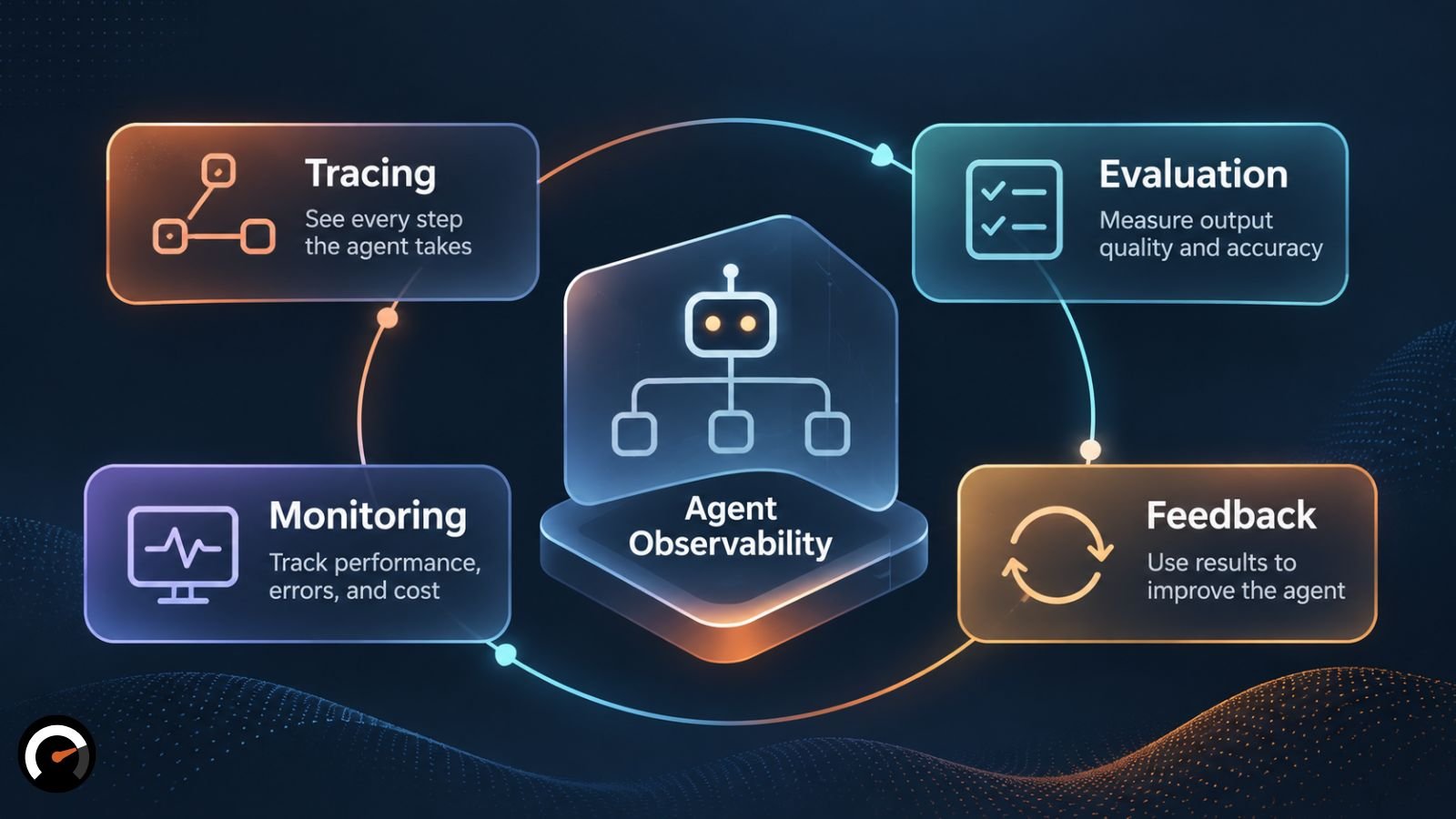
Tracing tells you what happened. Which model got called, which tool stalled, which step broke. Evaluation tells you whether the result was any good, scoring things like correctness, instruction-following and retrieval quality. A tool can excel at one and stay mediocre at the other, so be clear about which problem you’re paying to solve. Most teams end up needing both, along with a way to collect human feedback and follow handoffs between agents. Running agents in production also calls for a dedicated evaluation and monitoring layer that goes beyond raw traces.
LangSmith: strong LangChain fit, now a wider platform
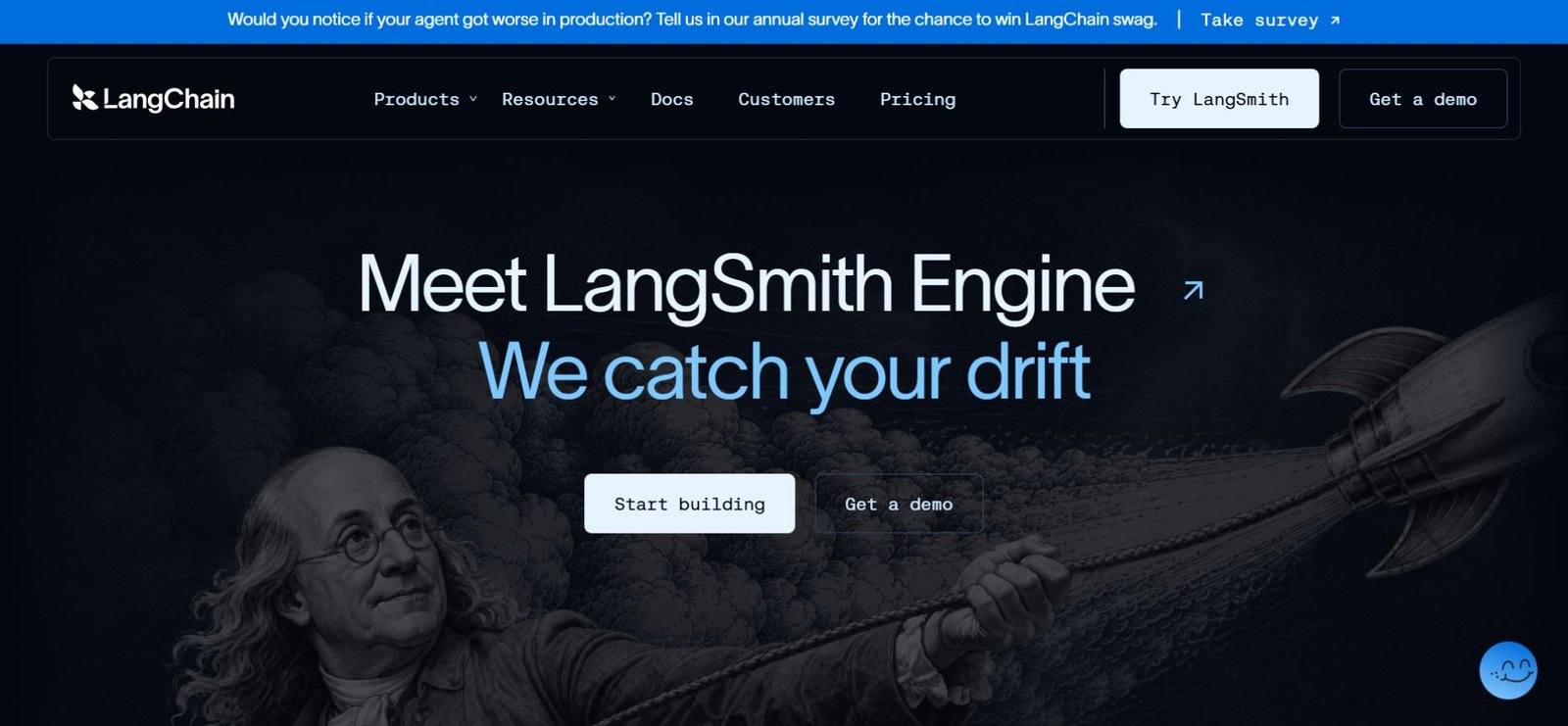
LangSmith has grown well past a trace viewer. Its pricing page now bundles observability and evaluation with Engine, LLM Gateway, Sandboxes, Deployment and Fleet. All of them draw on LangChain Standard Units (LSUs), and one LSU costs $1
LangSmith seats and trace pricing
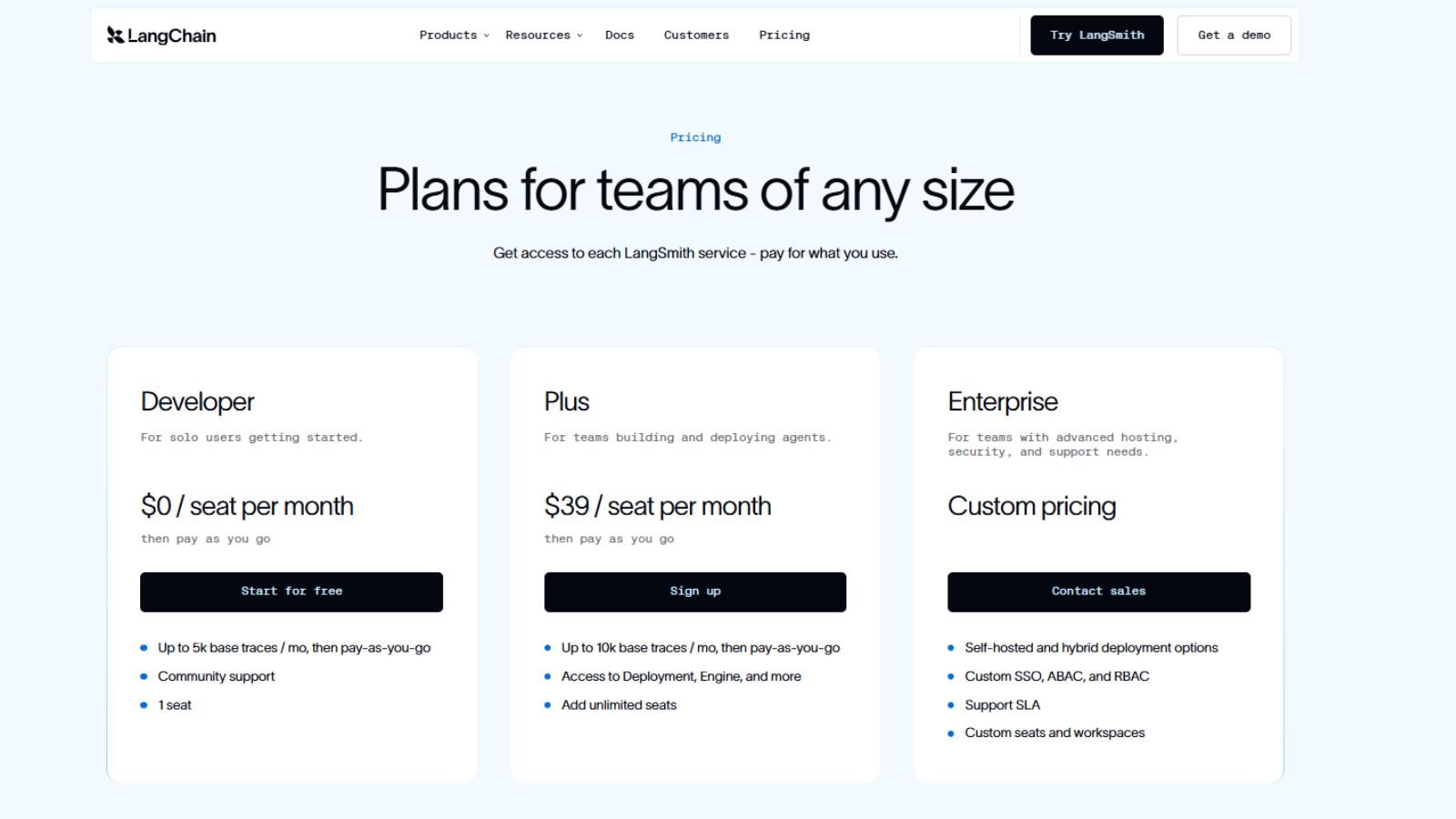
The Developer plan gives one person a free seat and 5,000 base traces a month. Plus runs $39 per seat with 10,000 base traces included, and Enterprise is quote-only. Watch the seat count, though: LangChain bills every user in your organization, invited users included. For example, five people on Plus means $195 a month before a single trace goes over the allowance.
Above the allowance you pay as you go, but the pricing page tucks the per-trace rate into a tooltip. Pricing trackers record it as 0.005 LSU, or $5 per 1,000 base traces, plus 0.0025 LSU when a trace gets upgraded to extended retention. LangChain’s own billing documentation still lists an older, lower rate, so its two sources don’t match.
How retention upgrades raise the bill
Retention is where bills creep up. LangSmith’s usage and billing documentation explains that online evaluators and automation rules can bump a trace into longer, pricier retention. New evaluators and rules come with that switch turned on, and one matching run is enough to upgrade the entire trace. You can opt out per evaluator or rule, but you have to remember to. Meanwhile, base traces last 14 days. The pricing page says extended traces now last 180 days, yet some documentation pages still describe a 400-day default. If retention matters for audits or compliance, get the number in writing.
Framework fit and hosting options
LangSmith will take OpenTelemetry traces from any compatible app. Its richest integration, though, is with LangChain and LangGraph. The client SDKs are open source; the backend, UI and storage layer aren’t. Self-hosted and hybrid setups come only with Enterprise, and hybrid here means LangChain runs the control plane while your data plane stays on your own infrastructure.
Arize Phoenix: free self-hosting under a source-available licence
Phoenix sits on top of OpenTelemetry. Arize also maintains OpenInference, its set of OTel conventions for LLM spans. According to Arize, Phoenix ships under the Elastic License 2.0, costs nothing to self-host and holds no features back. Arize calls that open source. The Open Source Initiative doesn’t recognize the licence, though, so “source-available” is the accurate label. In practice, the one real restriction is that you can’t sell Phoenix to customers as a hosted or managed service. Unless you plan to resell it or build it into a hosted product, you’ll never bump into that line.
Arize AX plans and overage
Also, don’t mix up Phoenix and Arize AX. Phoenix is the free tool you run yourself; AX is Arize’s commercial cloud. Arize’s AX pricing documentation gives AX Free 25,000 spans and 1 GB of ingestion a month, kept for 15 days. AX Pro costs $50 a month for 50,000 spans, 10 GB and 30-day retention. After that, you pay $0.0008 per extra span and $3 per extra GB. Self-hosting AX requires the custom-priced Enterprise tier.
Weights & Biases Weave and CoreWeave Agent Lens
Weave’s Python library carries an Apache 2.0 licence. The hosted W&B service is a separate, commercial product, so judge the SDK and the platform independently. Since the acquisition, W&B belongs to CoreWeave.
Here’s where the roadmap gets tricky. CoreWeave’s Agent Lens documentation names Agent Lens the recommended way to trace, monitor and analyze agents, and Weave’s own docs describe it as Weave’s successor for agent tracing. Both read the same trace data, so your existing agent traces show up in Agent Lens with nothing to migrate. Agent Lens is still a public preview, however. Evaluations, function-level tracing through Ops and Calls, and guardrails all still live only in Weave. If your team relies on any of those today, plan on running the two side by side for now.
Weave pricing on CoreWeave Forge
On the billing side, Weave charges mostly for data ingested, unlike the span-based tools. The CoreWeave Forge pricing page gives Free users 1 GB of Weave ingestion a month. Pro starts at $60 a month with 1.5 GB and targets organizations under 50 employees. Beyond the allowance, Pro bills $0.10 per MB, which works out to about $100 per GB, and Enterprise bills $0.20 per MB. Agents that log full prompts and responses on every step will run that meter up faster than you’d guess from their span count.
Langfuse: MIT-licensed core, unlimited users on paid cloud
ClickHouse bought Langfuse in January 2026. Even so, the core stayed MIT licensed and self-hostable. Langfuse says its optional Enterprise licence only adds governance extras like project-level RBAC, audit logs and data retention policies, and you can run the platform without it. Still, check the current licence docs before counting on a specific governance feature in your self-hosted copy.
Langfuse Cloud plans
The Langfuse pricing page lists four cloud plans:
- Hobby: free, with 50,000 units, 30-day data access and two users.
- Core: $29 a month, with 100,000 units, 90-day access and unlimited users.
- Pro: $199 a month, with the same 100,000 units and three-year access.
- Enterprise: $2,499 a month.
Above the allowance, Core and Pro first charge $8 per extra 100,000 units. That rate slides to $7, then $6.50, then $6 once you pass 1 million, 10 million and 50 million units. However, Pro has a catch: enterprise SSO, SSO enforcement and project-level RBAC need a $300-a-month Teams add-on, which pushes the base to $499. For a growing team, though, unlimited users on Core still beats paying LangSmith for every seat.
Units and self-hosting costs
A Langfuse unit counts traces, observations and scores together, so a single agent run can rack up many of them. Base your estimate on the events each run actually records rather than on request volume.
Self-hosting isn’t free of effort, however. Langfuse’s own docs say Docker Compose is fine for testing and light use but lacks high availability, scaling and backups. For production they point you to Kubernetes. Whatever tool you self-host, your real bill depends on volume, retention and the servers you’re willing to babysit.
Braintrust and other alternatives
Braintrust earns its spot when evaluation and regression testing carry as much weight as production tracing. There’s a free Starter plan, Pro at $249 a month, and an Enterprise tier with custom limits plus BYOC or self-hosted deployment. Pro covers 5 GB of processed data and 50,000 scores, then charges $3 per GB and $1.50 per 1,000 scores. In addition, users are unlimited on every plan. It’s proprietary software, so look hard at its data-export options before you treat it as a drop-in LangSmith replacement.
In addition, a few others deserve a look. MLflow and Laminar both accept OpenTelemetry traces under Apache 2.0, and Helicone takes a gateway-first route. APM giants such as Datadog bill for LLM spans as well. Be wary of comparison pages for any of these tools, since many come from vendors who conveniently rank themselves first.
Billing meters, seats and self-hosting compared
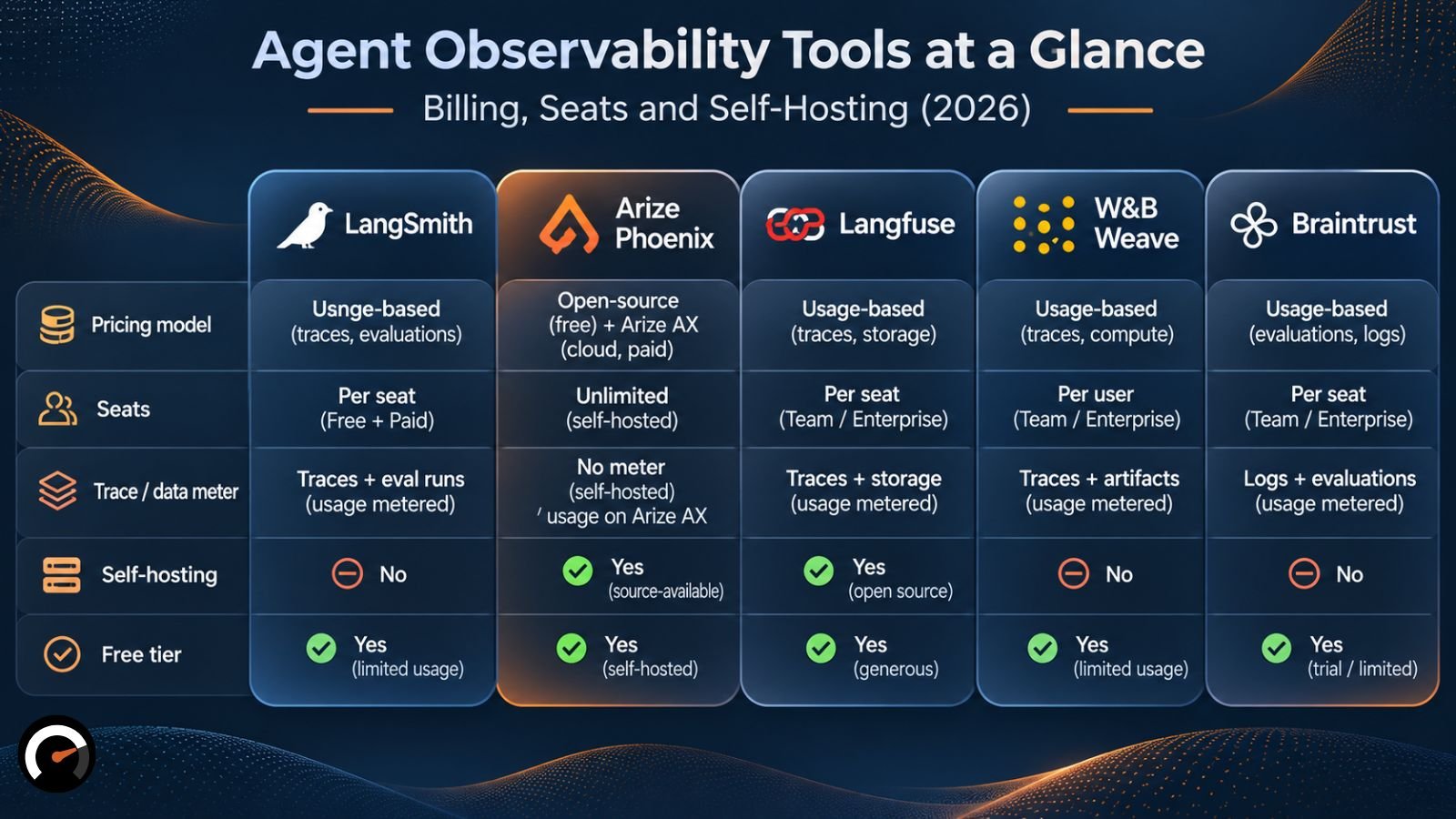
A trace isn’t a span, and neither one equals a Langfuse unit. Ten thousand of each can describe wildly different amounts of work. Therefore, before you compare monthly prices, work out how many records each platform would log for the same workload.
Also, keep observability costs separate from model costs. Every tool here bills for recording what your agent did; the LLM provider bills separately for the tokens the agent spent doing it. Observability spend is just one line in the full cost of deploying an agent, next to model tokens, hosting and human review.
| Platform | Licence | What the meter counts | Seat model | Self-hosting |
|---|---|---|---|---|
| LangSmith | Proprietary | Base traces and retention upgrades in LSU, plus other metered services | Per seat, invited users included | Enterprise (self-hosted or hybrid) |
| Phoenix | Elastic License 2.0 | Nothing; you pay for your own infrastructure | None | Free |
| Arize AX | Commercial | Spans and ingested data | Unlimited users on Free and Pro | Enterprise |
| Weave | SDK Apache 2.0; hosted service separate | Ingested data and storage | Up to 5 seats on Free, 10 on Pro | Enterprise private hosting only |
| Langfuse | MIT core; some add-ons licensed | Traces, observations and scores | Unlimited users on Core | Free core |
| Braintrust | Proprietary | Processed data and scores | Unlimited users on all plans | Enterprise |
Overage rates side by side
Overage rates show how far apart these meters really sit:
| Platform | Overage meter | Published rate |
|---|---|---|
| LangSmith Plus | Base trace | About $5 per 1,000 traces |
| Arize AX Pro | Span and data | $0.80 per 1,000 spans, plus $3 per GB |
| Langfuse Core | Unit | $0.08 per 1,000 units, falling with volume |
| Braintrust Pro | Processed data and scores | $3 per GB, plus $1.50 per 1,000 scores |
| Weave Pro | Ingested data | About $100 per GB |
The multi-agent multiplier
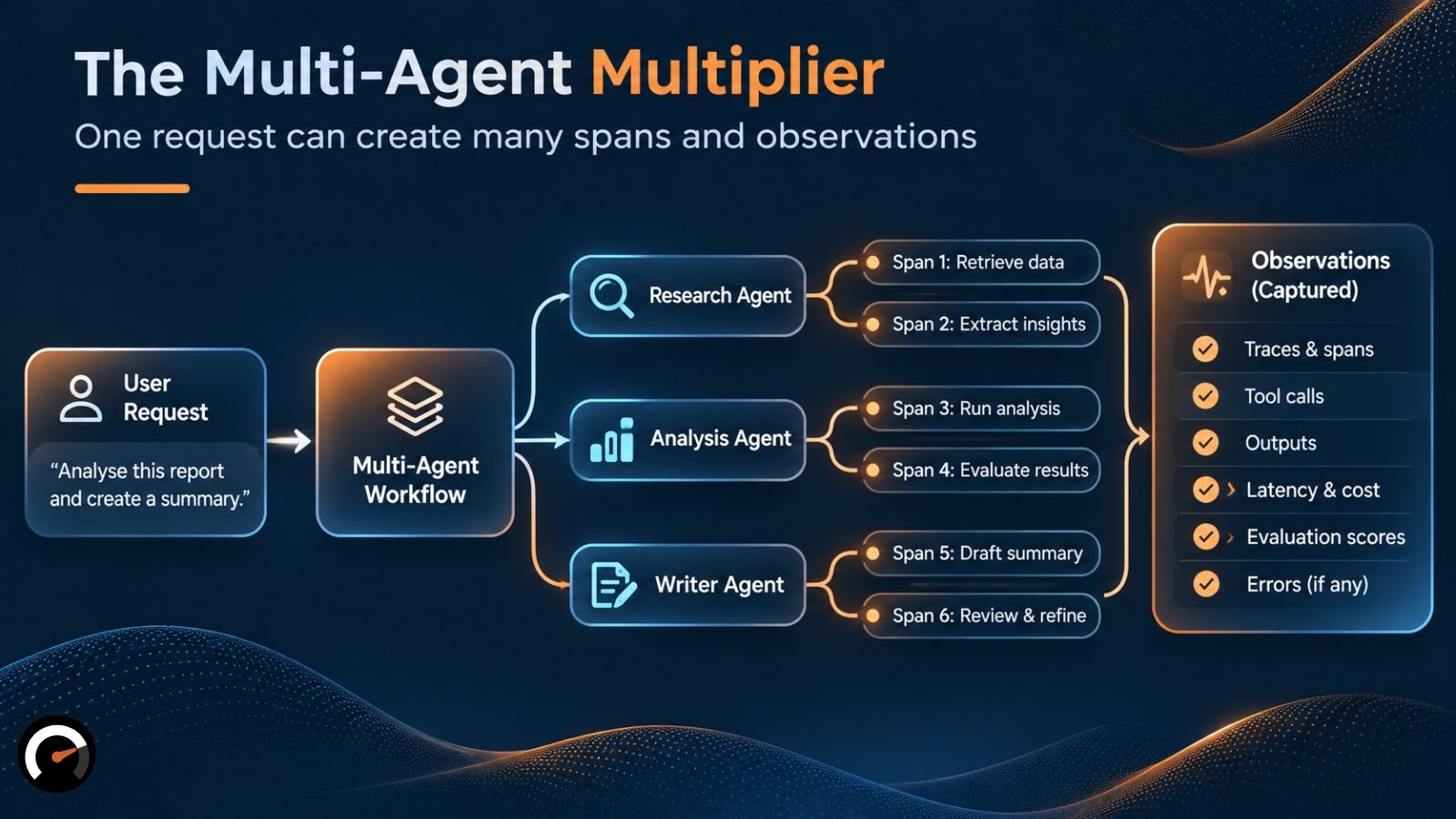
One user request to a multi-agent system can fire off 30 tool calls and sub-agent handoffs. LangSmith counts that whole run as one base trace. Langfuse and Arize AX count every step, so the same request becomes 30-plus units or spans. Still, neither approach is cheaper across the board; it depends on how chatty your agents are. Before you pick a meter, multiply expected user requests by the average number of steps per run.
A worked cost example
Here’s our sample math using the November 2026 rates. It’s an illustration, not a benchmark. For instance, say you log 1 million records a month on one paid seat. Langfuse Core comes to $29 plus nine extra blocks of 100,000 units at $8, roughly $101. Arize AX Pro lands at $50 plus 950,000 extra spans at $0.0008, about $810 before any data overage. LangSmith Plus reaches $39 plus 990,000 extra base traces at $0.005, close to $4,989. Those three workloads aren’t equal, because one LangSmith trace can wrap dozens of spans or units, so the same traffic produces far fewer LangSmith records. The spread still makes the point: the meter shapes your bill as much as the sticker price, and ingestion-priced tools like Weave reward teams that keep trace payloads lean.
Portability and lock-in
Use OpenTelemetry for instrumentation wherever you can, so switching vendors later doesn’t mean rewriting code. However, know its limits. OTel won’t carry over your evaluation datasets, prompts, dashboards, feedback workflows or vendor-specific metadata. Treat “can I move my instrumentation?” and “can I move everything?” as two separate questions, and try a real export and import before you commit. Langfuse, for one, publishes a migration cookbook for shifting traces, prompts and datasets between instances.
FAQs
Q. Is LangSmith free?
Only for one person. The Developer plan includes one free seat and 5,000 base traces a month, then switches to pay-as-you-go. As soon as you add a second user, you’re on Plus at $39 per seat.
Q. Is LangSmith open source?
The client SDKs are. The backend, UI and storage layer stay closed.
Q. LangSmith vs Langfuse: what is the main difference?
LangSmith is proprietary, charges per seat and works best with LangChain and LangGraph. Langfuse offers an MIT core you can self-host for free and unlimited users on paid cloud plans, but it bills by usage units.
Q. Is Arize Phoenix open source?
Technically it’s source-available under the Elastic License 2.0. Arize markets it as open source, but the Open Source Initiative doesn’t approve that licence. You can self-host it free; you just can’t resell it as a managed service.
Q. Is W&B Weave being replaced by Agent Lens?
For agent tracing, gradually. CoreWeave recommends Agent Lens and calls it Weave’s successor there, and both share the same trace data. Evaluations, function-level tracing and guardrails remain Weave-only for now.
Q. How much does W&B Weave cost?
The free tier covers 1 GB of ingestion a month. Pro starts at $60 a month with 1.5 GB, and each extra MB costs $0.10.
Q. Is Langfuse still open source after the ClickHouse acquisition?
According to Langfuse, nothing changed. The MIT licence, self-hosting and Cloud endpoints all stayed put, though a few governance add-ons require a commercial licence.
Q. Can I use LangSmith without LangChain?
You can, through OpenTelemetry or SDK wrappers. LangChain and LangGraph users simply get the deepest integration.
Related: Should AI Agents Have Their Own Identity? The Hidden Security Risks
| Disclaimer: This article is for informational purposes only. We are not affiliated with or endorsed by any platforms mentioned. Pricing, features, and licensing terms may change. Verify the latest details on official vendor websites. |
Test this on a real task
The audit is free and takes about ninety seconds. It returns a verdict, a readiness score and the supervision the task would need.
Run the audit