

Software vendors publish AI agent build estimates from about $5,000 to more than $400,000. Several of them put typical business projects between $20,000 and $300,000. Running the agent adds monthly costs for model tokens, hosting, monitoring, and the people who handle its mistakes.
Those are asking prices, not audited market averages.
Prices checked October 31, 2026. Token rates and software plans change often, so confirm them on each provider’s page before you budget.
Ask ten vendors what an AI agent costs, and you get ten answers. Both ends of that spread can be honest, because the vendors are describing different products.
Below, the bill is split three ways: building the agent, running it, and keeping it working. Token costs come from Anthropic’s price list with the math shown. Each figure says whether it’s a vendor claim, an official price, or my assumption.
The part most budgets get wrong: in the worked example, tokens come to about a tenth of first-year cost. People and the build eat most of the rest.
What does AI agent deployment cost include?

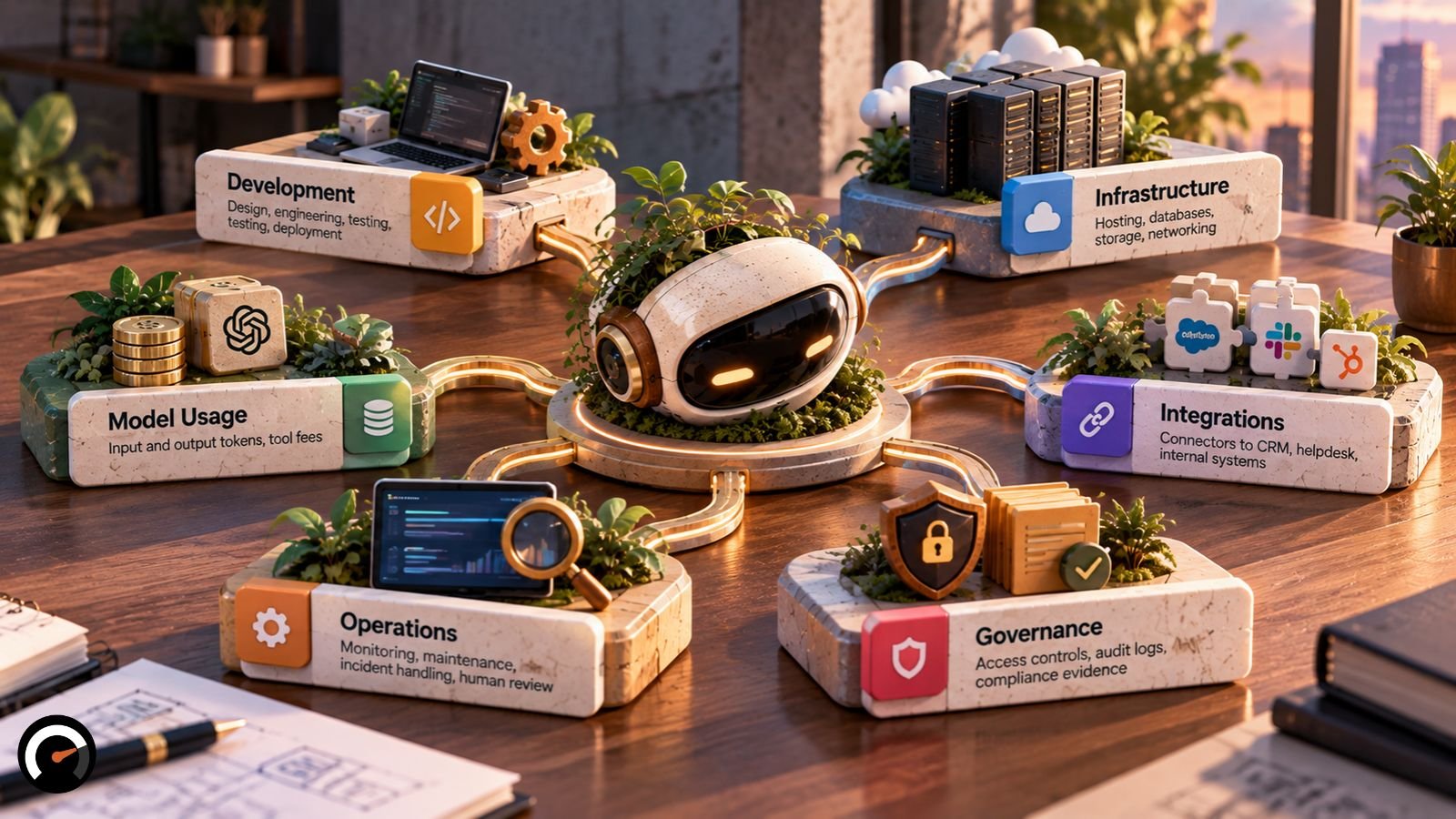
AI agent deployment cost is everything between signing a quote and running a system you can trust. Most vendor quotes cover only the first row of this table.
| Cost category | What it includes |
|---|---|
| Development | Design, engineering, testing, initial deployment |
| Infrastructure | Hosting, databases, storage, networking |
| Model usage | Input and output tokens, plus tool fees such as web search |
| Integrations | Connectors to CRM, helpdesk, and internal systems |
| Operations | Monitoring, maintenance, incident handling, human review |
| Governance | Access controls, audit logs, compliance evidence |
What do vendors say it costs to build an AI agent?
Published vendor estimates for building an AI agent run from about $5,000 to more than $400,000. All six companies sell that work, which is worth remembering as you read.
| Vendor | Published build range | Worth knowing |
|---|---|---|
| SolGuruz | $5,000 to $200,000+ | Prices four autonomy tiers separately |
| TekRevol | $8,000 to $400,000+ | Adds $500 to $20,000+ a month to run |
| Riseup Labs | $8,000 to $250,000+ | Its $450K headline figure is a year-one total, not a build price |
| HyperSense | $20,000 to $300,000 | Assumes an 8–12 week build |
| Biz4Group | $20,000 to $60,000 | Lowest ceiling in the set |
| Sparkout | $25,000 to $300,000+ | Prices an MVP agent at $25,000–$50,000 |
Riseup Labs’ summary quotes $10K to $450K+. Its detailed breakdown shows why the top number is misleading: build tiers stop at $250,000+, while year-one all-in totals for enterprise agents reach about $400,000–$450,000. Compare build prices with build prices.
Why do AI agent cost estimates disagree so much?
AI agent quotes disagree because of four things: how much the agent may do alone, where the engineers work, how loosely vendors publish numbers, and what “agent” means to the seller. Agencies also publish ranges that attract the buyers they want.
Autonomy level sets the price tier
SolGuruz publishes four tiers that show how much autonomy alone moves the build price:
| What the agent may do | SolGuruz build price |
|---|---|
| Recommend only; a person decides | $5,000 – $10,000 |
| Act after a person approves | $10,000 – $15,000 |
| Act alone within set limits | $15,000 – $20,000 |
| Coordinate other agents | $30,000 – $50,000+ |
Those tiers sit well below several competitors’ ranges for similar-sounding products. SolGuruz also says many teams ask for more autonomy than the job needs. The approval tier is often the cheapest version that still does the work.
Engineer location changes the bill more than tech choices
SolGuruz reports senior AI engineer rates of under $25 to $45 an hour in India and $80 to $150 in the USA. At those rates, the same 400-hour build costs about a third as much offshore.
SolGuruz sells offshore development, so read the figure with that in mind. The direction still holds.
Vendors contradict their own numbers
Riseup Labs’ summary puts entry-level agents at $20,000–$30,000, while the body of the same page starts them at $8,000. Sparkout’s headline range tops out at $300,000+, but its own FAQ says $250,000+. Published AI agent prices are rough marketing ranges, not price lists.
“Agent” has no fixed definition
In June 2025, Gartner reported that vendors were relabeling chatbots, assistants, and RPA as agentic AI, a practice it called “agent washing.” Gartner estimated that only about 130 of the thousands of agentic AI vendors offered real agentic capabilities.
Before you pay agent prices, check what counts as an agent for your task. Many workflows run fine on simpler rule-based automation tools, and those cost less to build and run.
What does it cost to run an AI agent each month?
Monthly running cost depends on volume, model choice, and how much human review the agent needs. SolGuruz puts it at $500 to $5,000 a month. Tokens are only one slice; storage, monitoring, tool fees, and people make up the rest.

Claude API token prices
Anthropic’s official pricing page lists these standard API rates per million tokens (MTok):
| Model | Input | Output |
|---|---|---|
| Claude Haiku 5.5, prompts up to 100K tokens | $0.10 | $0.50 |
| Claude Haiku 5.5, prompts over 100K tokens | $0.50 | $2.50 |
| Claude Sonnet 5.5 | $2 | $10 |
| Claude Opus 5.5 | $4 | $20 |
| Claude Fable 5.1 | $10 | $50 |
Other providers price differently, so check their pages before comparing.
Five pricing details that change a real Claude bill
- Prompt caching: Repeated input read from cache costs a small fraction of the normal rate. Sonnet 5.5 cache reads cost $0.10 per MTok, and Opus 5.5 cache hits cost 5% of its input price.
- Batch API: Work that can wait gets 50% off input and output.
- Tokenizer: Claude Opus 4.7 and newer models, including Sonnet 5 and Fable 5, use a tokenizer that produces roughly 30% more tokens for the same text than older Claude models. Anthropic’s token counting docs recommend counting again with the model you plan to run.
- Data residency: Requesting US-only inference on the Claude API adds a 1.1x multiplier on Opus 4.6, Sonnet 4.6, and later models. Default global routing uses standard prices. Bedrock and Google Cloud set their own regional pricing.
- Tool fees: Web search costs $10 per 1,000 searches, plus the tokens used to read the results.
Worked example: token cost for a support agent
These numbers are my assumptions, not measured data. A support agent handles 10,000 conversations a month. Each conversation makes 4 model calls, and each call sends 6,000 input tokens and returns 500 output tokens. That adds up to 240 million input tokens and 20 million output tokens a month.
| Model | Monthly token cost |
|---|---|
| Haiku 5.5 | $34 |
| Sonnet 5.5 | $680 |
| Opus 5.5 | $1,360 |
The table ignores retries and discounts. Caching alone changes the picture fast. If 5,000 of each call’s 6,000 input tokens are a fixed system prompt, Sonnet 5.5 reads them from cache at $0.10 instead of $2 per MTok. The Sonnet bill drops from $680 to roughly $300 a month, before cache-write charges.
Infrastructure and monitoring costs
Supporting tools add smaller recurring fees. These plan terms were checked October 31, 2026, so confirm them before you budget:
- Vector database: Pinecone charges a $50 monthly minimum on Standard and $500 on Enterprise, with usage billed above that. A flat $20 Builder plan covers smaller workloads.
- Observability: LangSmith Plus costs $39 per seat per month and includes 10,000 base traces, then switches to pay-as-you-go. LangSmith counts one execution as one trace, even when that execution makes several model calls.
- Cloud hosting: HyperSense estimates $200 to $2,000 a month depending on scale. That vendor estimate bundles several line items.
What does the same work cost without an AI agent?
An AI agent’s price only means something next to what the work costs today. Before you compare quotes, write down the monthly cost of doing the task by hand:
Current monthly cost = tasks per month × minutes per task ÷ 60 × loaded hourly rate
Take the support workload above and the rates used later in this guide: 15 minutes per conversation at a $25 loaded hourly rate. Handling all 10,000 conversations by hand would take 2,500 hours, or $62,500 a month. Treat that as a ceiling, not a baseline. Escalated cases are usually the harder ones, so your real average handle time is probably shorter. Use your own numbers from your helpdesk.
The baseline also corrects a common accounting mistake. Conversations the agent escalates were already being handled by people. Only the build, the running costs, and the extra quality checks are new money.
Vendor examples show why the timeline matters. SolGuruz models a support agent that costs $40,200 in its first year and saves $32,760. That leaves a $7,440 shortfall in year one, then roughly $22,760 saved in year two once the build is paid for.
A hybrid setup, where AI drafts and a person approves, can land between the two. The trade-offs of augmentation versus full automation can change which number you should compare against. Support triage is also one of the tasks scored in AI Work Audit’s tier-1 support ticket audits.
What does an AI agent cost in its first year?
An AI agent’s first-year cost is the build plus twelve months of running it. In the illustration below, the biggest running line isn’t the model. It’s people handling the cases the agent hands back.
For scale, SolGuruz publishes one vendor example: a support-triage agent handling 4,000 tickets a month, with a $30,000 build and about $10,200 in first-year running costs. Running costs come to roughly 34% of the build. Treat it as one agency’s illustration, not a benchmark.

Illustrative first-year budget
This budget reuses the $30,000 build from the SolGuruz example and the 10,000-conversation workload above, running on Sonnet 5.5 without caching.
| Line item | Assumption | Year-one cost |
|---|---|---|
| Build | Vendor example quote | $30,000 |
| Model usage | $680 × 12 | $8,160 |
| Vector database | Pinecone Standard minimum, $50 × 12 | $600 |
| Observability | LangSmith Plus, 1 seat, one trace per conversation (exactly the 10,000 included) | $468 |
| Human handling of escalations | 5% of conversations escalate, 15 minutes each, $25/hour loaded rate | $37,500 |
| Maintenance | 15–25% of build (vendor rule of thumb) | $4,500–$7,500 |
| Hosting and other infrastructure | Not included; get a quote | — |
| Total (excluding hosting) | about $81,000–$84,000 |
Year two drops the build. The same setup then costs about $51,000–$54,000 a year, again excluding hosting.
How the escalation rate moves the total
| Escalation rate | Human hours a month | Cost a month at $25/hour |
|---|---|---|
| 2% | 50 | $1,250 |
| 5% | 125 | $3,125 |
| 10% | 250 | $6,250 |
Cutting escalations from 10% to 2% lowers the first-year total by $60,000. Switching from Opus 5.5 to Haiku 5.5 saves about $16,000 a year on tokens. Escalations matter almost four times as much as the model.
Quality sampling is a separate cost
Escalations are cases the agent hands to a person. Quality sampling is different: a person checks a share of the work the agent finished on its own. Budget it as its own line.
AI Work Audit’s published oversight sampling formula sets base sampling from 2% of output at bearable risk to 20% at serious risk. It assumes checking one unit takes 30% to 65% of the time producing it took. Its tier-1 ticket example reviews 11% of replies once the agent reaches steady state.
Sample size limits what a clean review proves. Finding zero faults in a sample of n only rules out error rates above roughly 3 ÷ n. Ruling out error rates above 1% takes about 300 reviewed units a month with no faults found.
How do you calculate cost per successful task?
Cost per successful task is the total monthly operating cost divided by the tasks the agent completed correctly. Counting every conversation hides failed attempts, retries, and escalations, so it understates the real unit cost.
Cost per successful task = total monthly operating cost ÷ successfully completed tasks
In the worked example, monthly operating cost is $680 (model) + $50 (vector database) + $39 (observability) + $3,125 (human handling) = $3,894. If 8,500 of 10,000 conversations finish correctly, each successful task costs about $0.46.
Leave out the human line and the same agent looks like it costs about $0.09 per task. That five-fold gap is the whole case for measuring per successful task.
Track this number from the agent’s first week. Compare it with your baseline cost per task: the monthly cost of doing the work by hand divided by the tasks handled. If the agent’s figure is not clearly lower, revisit the escalation rate or the build cost before scaling up.
Which costs do AI agent quotes leave out?
AI agent quotes usually cover the build and sometimes hosting. These costs tend to show up later:

- Integration: Cost depends on API quality, authentication, legacy systems, data cleanup, rate limits, and error handling. An agent that writes data needs far more work than one that only reads it. Two agents on the same model can need very different integration budgets.
- Maintenance: HyperSense suggests 15–25% of build cost per year, and Riseup Labs says 15–30%. Both companies sell that work.
- Model migrations: Providers retire models, and prompts need retesting when they do. SolGuruz advises budgeting one migration cycle a year.
- Upstream plan upgrades: Agents make far more API calls than people do. Your helpdesk, search, or data provider may push you to a higher tier on call volume alone.
- Governance retrofit: HyperSense says adding security and compliance controls mid-project can raise a budget by 20–30%. Planning scoped identities for agents and checking sensitive data exposure risks at the start costs less than bolting them on later.
- Contingency: HyperSense adds 30–40% to any vendor quote, while SolGuruz suggests 15–25%. Size your buffer by uncertainty instead: unclear integrations, messy data, compliance requirements, and expected review hours.
The largest risk is a project that never reaches production. Gartner’s June 2025 forecast says more than 40% of agentic AI projects will be canceled by the end of 2027, citing escalating costs, unclear business value, or weak risk controls. It’s a forecast, not a measurement, but the point stands: an agent can work and still lose money.
Should you build a custom AI agent, buy a platform, or use no-code?

Use an existing platform or a no-code tool for narrow workflows that touch low-risk data. Build custom when the agent spans several internal systems or needs tight permissions and audit trails. I found no independent source that compares the three routes on cost, so this table compares fit instead.
| Situation | Better starting point |
|---|---|
| One simple internal workflow | Existing platform |
| Basic customer support automation | No-code or low-code platform |
| Several systems with custom permissions | Custom or hybrid build |
| Sensitive actions that need detailed audit trails | Custom build or a tightly controlled enterprise platform |
| Unproven use case | Small pilot before any custom build |
No-code lowers upfront engineering cost; Sparkout lists $5,000 to $20,000 for no-code builds, a vendor claim. Subscriptions, usage limits, and vendor lock-in can erase that saving later. A hybrid approach limits early spend while you learn what the workflow really needs.
How do you build an AI agent budget that holds up?
Price one workflow, not “an agent.” Work through it in this order.
- Define one task and what “done” means. “Resolve a refund request without a human” beats “handle support.” A free task automation audit can score whether that task is worth automating before you request quotes.
- Measure your baseline. Record volume, handle time, and loaded hourly cost for the task as people do it now.
- Measure tokens on 20 real examples with the target model before trusting any estimate.
- Pick the smallest model that passes your tests, then price that model, with caching switched on.
- Estimate escalation and sampling rates. Run the escalation table above with your own numbers, and add quality sampling as a separate line.
- Ask vendors the questions that move the price:
- What autonomy level is quoted?
- Which systems can the agent write to, and is rollback included?
- What token volume does the quote assume, and what happens if it doubles?
- Is the price fixed, time-and-materials, per agent, or per outcome?
- Is evaluation included, and who owns the agent after launch?
- Is this a pilot price or a production price?
- Write kill criteria before you start, such as a maximum cost per successful task or a minimum success rate.
Which AI agent cost should you plan around first?
Plan around people, not tokens. The escalation rate, quality sampling, and maintenance decide whether an agent pays off, far more than the model you pick.
The worked example runs on my assumptions. Swap in your own volumes, handle times, and quotes before a budget goes to finance.
AI agent cost FAQs
Q. How long does AI agent deployment take?
HyperSense and Biz4Group both cite 8 to 12 weeks for typical business agents. SolGuruz gives 6 to 12 weeks for read-only agents, 3 to 5 months for agents that act alone, and 4 to 8 months for orchestrated setups with compliance needs. Integration and compliance work usually stretch these vendor estimates.
Q. Can you build an AI agent for free?
You can prototype for little or nothing. Anthropic gives new API users a small amount of free credit, and several platforms offer free tiers. A production agent at volume still pays for tokens, storage, monitoring, and human review.
Q. Which model keeps AI agent costs lowest?
The smallest one that passes your tests on real examples. In the worked example, Haiku 5.5 runs the same workload for $34 a month against $680 on Sonnet 5.5, so test the cheaper tier first.
Q. Does an AI agent cost less after the first year?
Yes, because the build is paid off. The example agent drops from about $81,000–$84,000 in year one to about $51,000–$54,000 in year two. Model migrations and upstream plan changes can still add unplanned costs.
Q. Do regulated industries pay more for AI agents?
Yes. Riseup Labs prices healthcare agents at $80,000 to $250,000+ and finance and insurance agents at $70,000 to $200,000+. Audit trails, data protection, and compliance validation drive the premium.
Related: Will AI Replace Real Estate Agents by 2030? What 2026 Data Reveals
| Disclaimer: This article is for informational and educational purposes only and does not constitute financial or professional advice. AI agent deployment costs are based on publicly available vendor estimates, published pricing, and illustrative calculations. Actual expenses may vary depending on project complexity, usage, infrastructure, and maintenance requirements. Always verify current pricing with providers before making investment or deployment decisions. |
Test this on a real task
The audit is free and takes about ninety seconds. It returns a verdict, a readiness score and the supervision the task would need.
Run the audit