
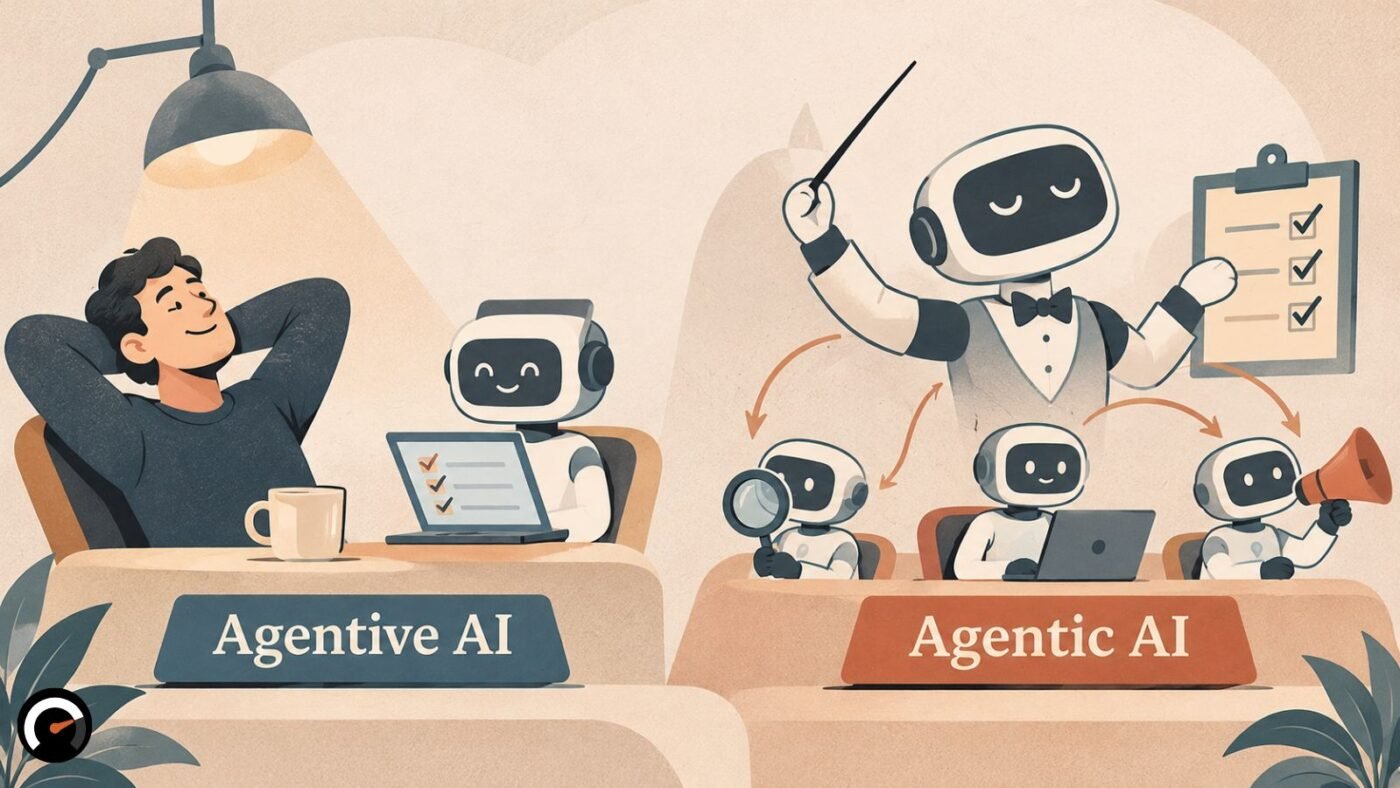
Agentive AI is software that does a job on your behalf, usually in the background, within limits you’ve set. The word traces back to designer Christopher Noessel. His 2017 book, Designing Agentive Technology, used it for narrow AI that watches for a trigger and then acts while you’re busy with something else.
That’s the original meaning, anyway. The word has wandered since. You’ll now find it used three ways, and two of them flatly contradict each other.
Nobody owns these definitions. No standards body stands behind “agentive” or “agentic,” so a product’s label won’t tell you much. What the product actually does will.
The Three Ways People Use “Agentive AI” Today

Read the pages ranking for this term and you’ll find three camps.
| Usage | Who uses it | What “agentive AI” describes | Acts without approval? |
|---|---|---|---|
| Noessel’s agentive technology | Design and UX writers, following the 2017 book | Narrow AI that monitors data, spots triggers, and acts for the user in the background | Yes, within limits the user set |
| Approval-gated assistance | Some vendors, such as Capacity and Creole Studios | AI that drafts, suggests, or flags, then waits for a human to approve | No |
| A synonym for agentic AI | Many tech blogs and explainers | Autonomous agents that plan, use tools, and finish multi-step tasks | Yes, often across many steps |
Capacity is the clearest case of the approval-gated camp. Its 2026 contact-center guide describes agentive AI as AI that assists and waits for your approval, and leaves independent action to agentic AI. Creole Studios draws the same line and lists Grammarly and Google Maps as agentive tools.
The synonym camp skips the distinction altogether. Redmondmag, for one, treats agentive AI and AI agents as the same thing: systems that decide and act on their own.
Even a single source can hold both views. That same Capacity page credits agentive AI with multi-step tool use, up to booking a flight for you. A few paragraphs later, it calls agentive AI “session-bound,” done the moment you close the chat. Noessel’s agent never clocks off.
Where the Term “Agentive” Came From
Noessel is an interaction designer who later worked on applied AI at IBM. He published Designing Agentive Technology: AI That Works for People with Rosenfeld Media in May 2017. The pitch was simple. Some software shouldn’t help you do a task. It should do the task for you.
In his framework, an agent watches data streams, responds to triggers with rules, and gets tuned by its owner over time. That’s how an excerpt from the book in UX Magazine sums it up.
Noessel’s four modes of agency
Noessel sorts technology by who does the work. He walked through four modes in a 2024 Rosenfeld Media talk:
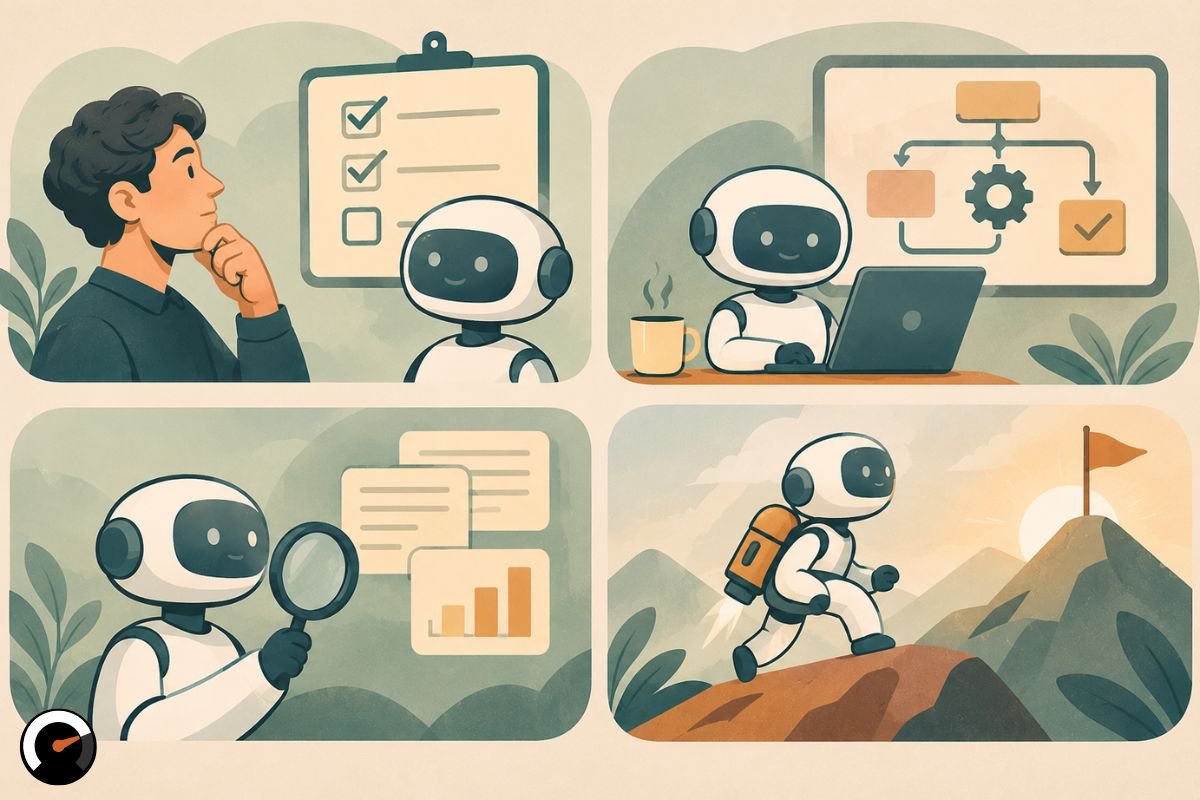
- Manual. You do the task with a plain tool.
- Assistant. Software helps, but you still do the task.
- Agentive. Software does the task, and you can watch or adjust it.
- Automation. Software does the task with nobody involved.
Agentive sits between assistance and full automation. You keep the goal and the right to step in, and the software does the legwork.
Agentive vs Agentic AI: What Is the Difference?
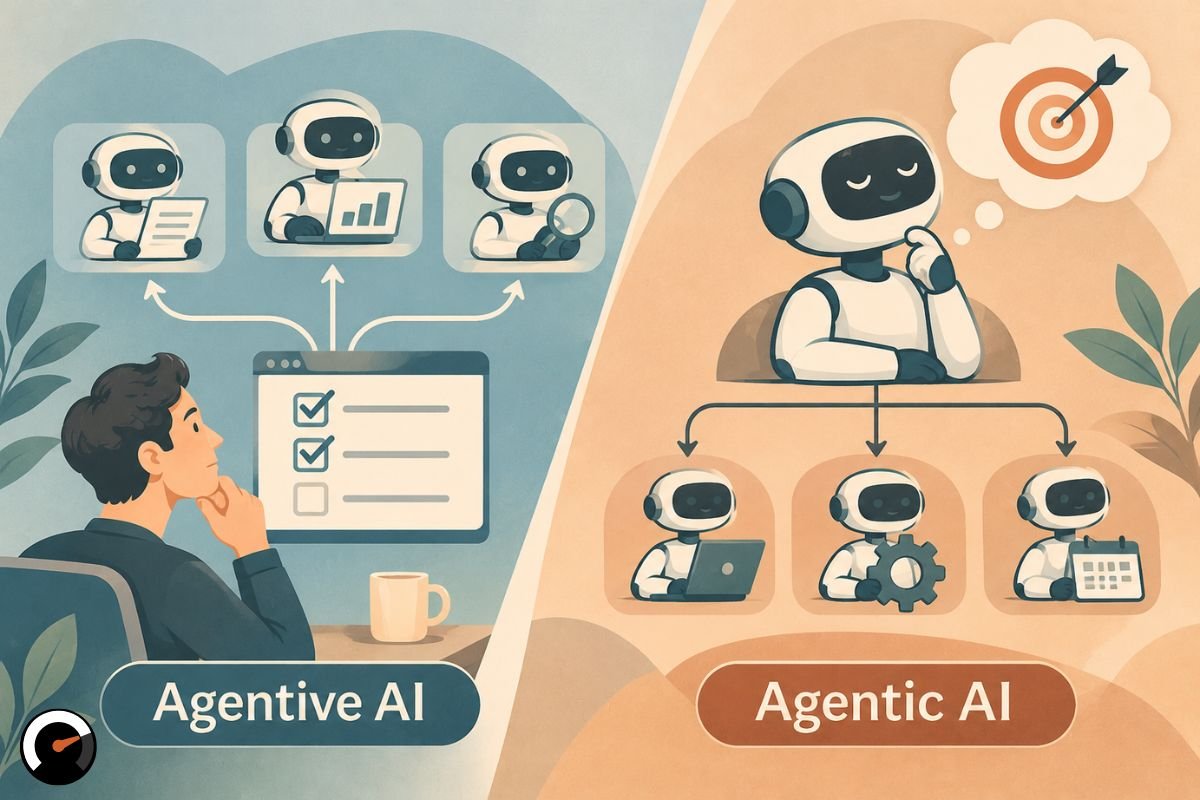
They describe two layers of one system. “Agentive” is about what it’s like to have work done for you. “Agentic” is about how the software behind the scenes gets that work done.
Noessel laid this out in a June 2024 post, Agentive Tech and Agentic AI: Cousins, Not Adversaries. He calls agentic AI a “back stage” idea about how code handles a request, and agentive tech a “front stage” idea about the user’s experience. His restaurant version sticks better: to the diner, the waiter is agentive and the kitchen is agentic.
Who is the boss of the agents?
The same post adds a second test, and it’s a handy one. Ask who the agents work for. In agentic AI, they report to a primary AI that coordinates them and pulls the result together. In agentive technology, they work for you.
Why the two layers don’t depend on each other
You can have either layer without the other. A plain rules engine that pings you when a threshold trips is agentive, and there’s no large language model anywhere in it. Now flip it. A powerful multi-step agent that makes you approve every click is agentic underneath, but it won’t feel agentive to the person babysitting it.
That’s why the two words keep bumping into each other. Neither is wrong. They just answer different questions.
What makes AI “agentic” in practice
Agentic systems chase a goal over several steps, usually by planning and calling tools. MIT professor Phillip Isola put it in one line in an MIT News interview: agentic AI is AI that takes actions in the world.
Andrew Ng’s four design patterns (reflection, tool use, planning, and multi-agent collaboration) are the usual reference for how these systems get built. Every one of them describes the kitchen. None of them says how the dining room feels.
Examples of Agentive AI, at Home and at Work
Noessel’s own examples are still the cleanest. Each one handles a job while your attention is somewhere else.
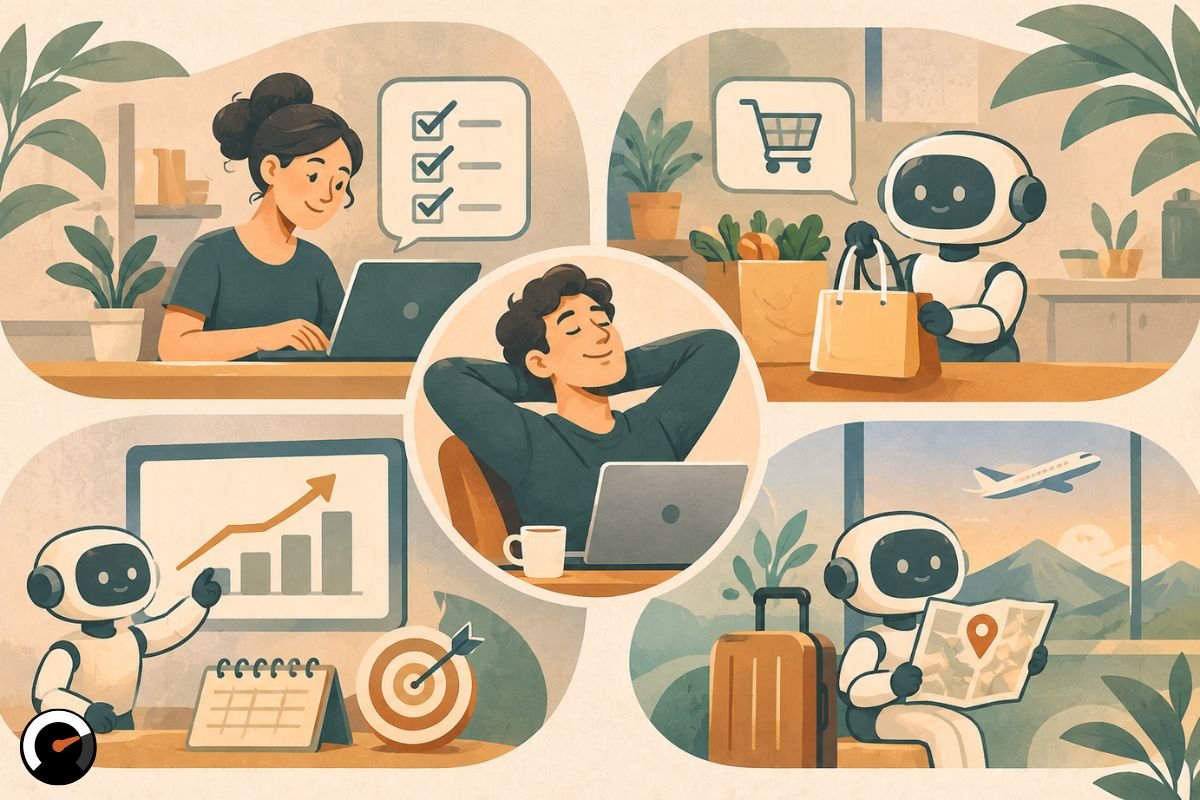
- Automatic pet feeder. Set the schedule once, and the cat gets fed whether you’re home or not.
- Smart thermostat. The book opens on the thermostat’s slow evolution from a manual dial into something that adjusts the heat for you.
- Robot vacuum. Noessel has described the Roomba as a machine you tell when to clean, and then it just does. It isn’t a fancier way for you to vacuum.
Workplace jobs that fit the agentive model
The same shape shows up at work. A few illustrative patterns, not specific products:
- a monitor that watches a support queue and escalates tickets that break a response-time rule
- a price watcher that checks supplier rates each day and pings purchasing when one crosses a set line
- a scheduler that moves a meeting when a conflict appears, following rules its owner wrote
Each one has a trigger, a rule, an action, and a person who can tune or override it.
Why popular “agentive” examples often don’t fit
Vendor lists like to name Grammarly, Google Maps route suggestions, and Spotify recommendations as agentive. By Noessel’s definition, they’re assistive. They help while you do the task, and you accept or reject each suggestion yourself.
Grammarly shows how slippery this gets. Creole Studios calls it agentive. Grammarly describes its own writing agents as agentic AI that work proactively as you type. One product now wears both labels, and under Noessel’s test neither quite fits.
Whether a tool helps or does the work also changes what it costs to run and who has to check it. That’s the heart of the augmentation versus full automation trade-off.
How to Tell What an “Agentive” Product Actually Does
Skip the label and watch the behavior. These four questions place a product more reliably than either word can:
- Does it watch a trigger on its own? That could be a schedule, a threshold, an incoming message, or a calendar change.
- Does it act without a fresh prompt? Or does it sit idle until you ask?
- Does it need approval before each action? Or does it work within rules you set up front?
- Does it plan several steps and call tools? Or does it run one fixed action?
Here’s roughly where the answers land:
| What the product does | Where it fits |
|---|---|
| Watches a trigger and acts within preset rules, no per-step approval | Agentive, in Noessel’s sense |
| Suggests or drafts, then waits for you to approve | Assistive, or “agentive” in the vendor sense |
| Plans multiple steps and calls tools to reach a goal | Agentic architecture |
| Runs a fixed task that no person can tune or stop | Automation |
Plenty of products mix these. OpenAI’s ChatGPT agent, released in July 2025, plans and acts on its own virtual computer. Yet it still stops for confirmation before purchases and other consequential steps. Agentic underneath, approval-gated on top.
Vendor pages rarely answer these questions straight. Independent, hands-on AI tool reviews tend to be more honest about it, since they report what a product did in real use rather than what its landing page promises.
When Should a Task Use Agentive or Agentic AI?
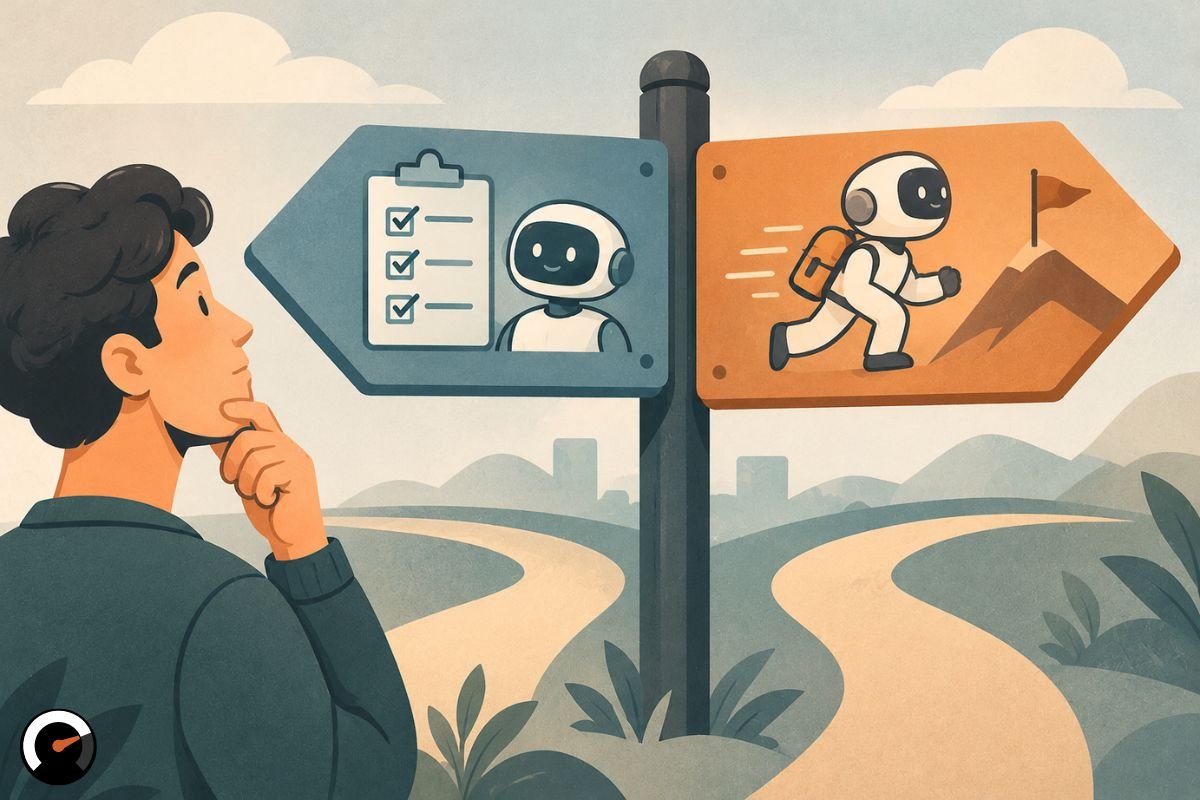
Pick by what a wrong action would cost you, not by which label sounds smarter. The four checks below are our editorial framework, not an industry standard.
Is the trigger predictable? Fixed triggers, like an alert when a number crosses a threshold, suit an agentive setup. Plenty of these jobs don’t need a language model at all, which is where the line between rules-based automation and AI starts to matter. Open-ended goals (“compare these five suppliers and draft a summary”) lean toward agentic planning.
Can the action be undone? Moving a meeting is easy to reverse. A payment, a signed contract, or a deleted record isn’t. Put an approval step in front of anything you can’t take back, even if the system could act alone.
Who owns the mistakes? Name that person before launch. It gets harder with multi-step agents that touch several systems, since an error can surface a long way from where it started.
Does the value cover the supervision? Someone still has to review a sample of the agent’s output, and that time costs money. Model fees, hosting, and monitoring sit on top of it, all part of the real cost of deploying an AI agent.
AI Work Audit scores individual tasks the same way. Repeatability, judgment, and risk count for more than savings. When an error could cause legal, financial, or safety damage that’s hard to reverse, the cost-optimized options get blocked outright. The method is public, so you can read how the verdict is scored before trusting it.
Risks and Limits of Agentive and Agentic AI
Four problems keep coming up: wasted spend, relabeled products, privacy, and people losing the skill to catch mistakes.
Wasted spend. In June 2025, Gartner forecast that over 40% of agentic AI projects will be canceled by the end of 2027. It pointed to rising costs, unclear business value, and weak risk controls. Keep in mind it’s a prediction, not a measured result.
Relabeled products. The same release warned about “agent washing,” where vendors rebrand chatbots, RPA tools, and assistants as agentic. Gartner put the number of genuinely agentic vendors at about 130, out of thousands. We’d expect “agentive” to get the same treatment, which is exactly why the behavior test matters.
Gartner wasn’t all gloom, though. It also expects at least 15% of day-to-day work decisions to be made autonomously through agentic AI by 2028, up from 0% in 2024. It sees 33% of enterprise software applications including agentic AI by then, up from under 1%.
Privacy. An agentive system has to watch a data stream to act on it. So it needs standing access to email, calendars, tickets, or transactions. In the book, Noessel leaves open some hard questions about bias and how agentive tech could be abused.
Skill loss. In that same 2024 talk, Noessel flags deskilling and overreliance as real risks. Let software run a job in the background long enough, and people may stop noticing when it gets the job wrong.
Frequently Asked Questions About Agentive AI
Q. What is agentive AI in simple terms?
It’s software that does a task for you, often in the background, within rules you set. Christopher Noessel coined the term in 2017. Today, some vendors use it for AI that drafts and waits for approval, while others treat it as another word for agentic AI.
Q. Is agentive AI the same as agentic AI?
No. For Noessel, agentive describes the front-stage experience of having work done for you. Agentic describes the back-stage machinery that plans steps and calls tools. Some vendors use agentive to mean a lower-autonomy version of agentic instead.
Q. How do you pronounce “agentive”?
“A-jen-tiv,” with the stress on the first syllable. Noessel says he picked that pronunciation because it points back to the root word, “agent.”
Q. Is ChatGPT an example of agentic AI?
A normal chat reply isn’t, since it produces text without taking action. ChatGPT agent, launched in July 2025, is agentic. It plans and acts on its own virtual computer, though it still asks before purchases and other consequential steps.
Q. Are AI agents and agentic AI the same thing?
Not quite. An AI agent is any system that acts toward a goal, simple rule-based ones included. Agentic AI usually means agents that plan, reason, and adapt over many steps. The split is easier to see once you know how AI agents work.
Agentive AI Is a Design Question, Not a Product Category
Judge a tool by what it does. Does it watch a trigger, act without being asked, wait for approval, or plan across steps? Then match that to the job. Predictable, reversible work suits an agentive setup. Costly or permanent actions need a human checkpoint, whatever the product calls itself.
None of these terms has a formal definition, and vendors keep moving the goalposts. The Gartner numbers are forecasts, so they’re worth checking again once 2027 and 2028 results come in.
Related: Should AI Agents Have Their Own Identity? The Hidden Security Risks
| Disclaimer: This article is for informational and educational purposes only. Definitions of agentive AI and agentic AI may vary across researchers, vendors, and industry sources. The examples and comparisons reflect publicly available information and should not be considered technical, business, or professional advice. Readers should independently evaluate AI tools before adopting them. |
Test this on a real task
The audit is free and takes about ninety seconds. It returns a verdict, a readiness score and the supervision the task would need.
Run the audit