

Enterprise AI agent projects rarely stall because the model can’t do the work. They stall because someone picked the wrong workflow, underestimated the integration, or bolted on risk controls after the demo had already impressed the board.
Gartner put a number on the problem in June 2025. It forecast that more than 40% of agentic AI projects will be canceled by the end of 2027, citing rising costs, unclear business value and inadequate risk controls. It’s a prediction rather than a measured outcome. It’s still reason enough to write your stop criteria before anyone opens a code editor.
This article gives you an operating framework for autonomous AI agents:
- Five layers that decide where an agent belongs and how it runs.
- An autonomy scale that limits what the agent may do alone.
- A supplier-invoice walkthrough that shows the controls in place.
- A readiness scorecard you can apply to one workflow this week.
- A short map of the standards that matter.
Method note: the five layers, autonomy scale, tables, control mapping and scorecard are this article’s synthesis of the sources linked throughout. They are not an industry standard.
What is an enterprise automation framework for autonomous AI agents?
An enterprise automation framework for autonomous AI agents is a written set of decisions. It records which processes an agent may run, which systems it can reach, who signs off on its actions, and how its results get measured. It works for vendor agents and in-house builds alike.
MIT Sloan describes agentic AI as semi- or fully autonomous systems that perceive, reason and act. They usually plug into other software to finish tasks with little human supervision. The same piece admits there’s no universally agreed definition, which leaves plenty of room for marketing.
Gartner calls that marketing “agent washing”: chatbots, AI assistants and robotic process automation (RPA) relabelled as agentic. In June 2025, Gartner estimated that only about 130 of the thousands of vendors claiming agentic AI were real.
You can run your own check in a few minutes. Ask whether the system:
- Plans its own steps toward a goal.
- Chooses which tool to call.
- Changes course when the input changes.
If it only follows a fixed script, it’s automation, whatever the sales deck says. For the mechanics behind a genuine agent, read how an AI agent works.
Operating framework vs. development framework: which one do you need?
You need both, because “framework” means two different things in agent searches.
An operating framework, like this one, governs how agents get chosen, controlled, measured and rolled out. A development framework is the code you build agents with. LangGraph, CrewAI, Microsoft Agent Framework, Google’s Agent Development Kit (ADK) and the OpenAI Agents SDK all sit in that second group. Managed platforms such as Amazon Bedrock AgentCore and Salesforce Agentforce add hosting and tooling on top.
Your choice of development framework settles how agents get built. It leaves open who approves their actions, which identity they run under, and who watches them in production.
| Decision factor | Lean toward a development framework | Lean toward a managed platform |
|---|---|---|
| Systems involved | Custom or legacy systems across vendors | Mostly one vendor’s application suite |
| Team | Engineers who can own code, tests and evaluations | Business teams with a small platform group |
| Control needs | Custom authorization logic and logging | The vendor’s built-in control model is acceptable |
| Lock-in tolerance | Low | Higher |
| Either way | Check MCP and A2A support first | Check MCP and A2A support first |
When should an enterprise use an autonomous agent instead of RPA or a human?
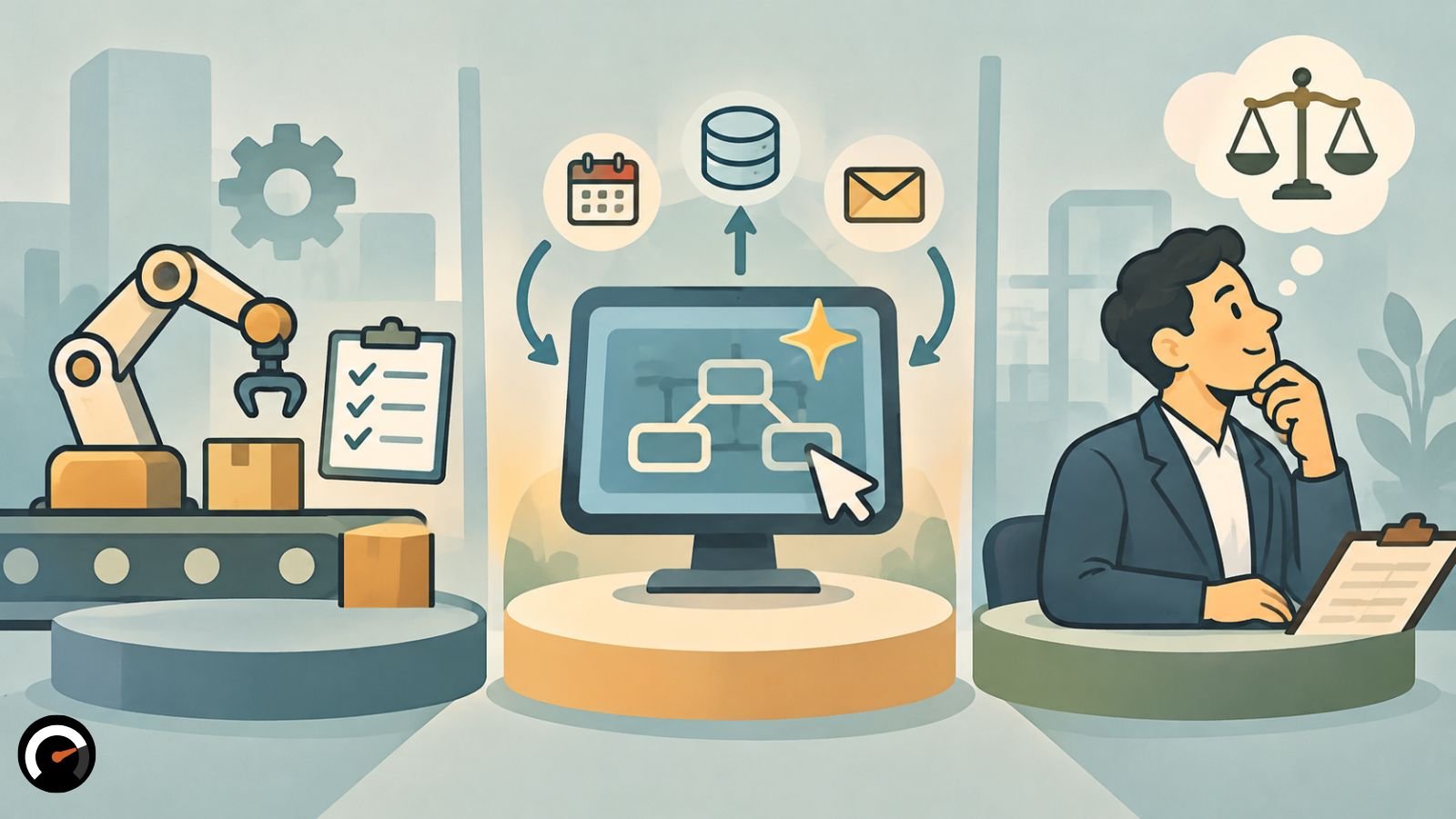
Reach for an autonomous agent when inputs vary, the path shifts case by case, and a wrong step is cheap to catch. Stable steps belong to rule-based automation or RPA. Decisions with legal weight or real potential for harm stay with a person until someone can explain the agent’s reasoning.
Gartner puts it more bluntly: many use cases sold as agentic don’t need an agentic implementation at all.
| Approach | Best for | Weak at | Choose it when |
|---|---|---|---|
| Rule-based automation or RPA | Stable, high-volume, rule-bound steps | Variable inputs and exceptions | Steps never change and audits need identical output |
| Autonomous AI agent | Multi-step work with messy inputs and case-by-case decisions | Consistency, explainability, cost control | Errors are cheap to catch and outcomes are measurable |
| Human decision | High-stakes, legally weighty or novel judgments | Speed and volume | Harm is serious and the agent’s reasoning isn’t yet explainable |
Real workflows rarely land in one column. A single process might use rules for intake, an agent for triage and a person for the final call. The line between rule-based automation and AI usually runs through individual steps rather than whole processes.
Why do enterprise AI agent projects stall?
Three causes come up again and again: a weak business case, integration work nobody budgeted for, and late risk controls. Those match the reasons behind Gartner’s cancellation forecast. Gartner also flags legacy integration as technically messy and disruptive to existing workflows.
One published deployment shows where the hours actually go. MIT Sloan’s Kate Kellogg and colleagues documented an agent at Mass General Brigham that scanned clinical notes for immune-related adverse events in cancer patients. According to their field guide, prompts and model development took under 20% of the effort. More than 80% went to implementation work:
- Data integration
- Model validation
- Proving economic value
- Managing drift
- Governance
That’s one hospital and one use case, so the exact ratio won’t carry over to your finance team. The direction probably will: budget for the plumbing before the prompts.
Kellogg also flags a common accounting mistake. If an agent frees up 20% of someone’s time, payroll doesn’t shrink by 20%. Tie agent metrics to business results instead of hours saved.
What are the five layers of the framework?

The framework has five layers: use-case fit, system access, orchestration, governance and identity, and evaluation and monitoring. Skip one and the gap usually surfaces in production.
| Layer | Core question | Decisions to record | Typical failure when skipped |
|---|---|---|---|
| 1. Use-case fit | Is this workflow worth an agent? | Outcome metric, baseline, stop criteria | A pilot that can never prove value |
| 2. System access | What can the agent touch? | Tools, data and credentials at minimum scope | An over-permissioned agent |
| 3. Orchestration | How do steps run and recover? | Step order, workflow state, retry and failure rules | Half-finished runs nobody notices |
| 4. Governance and identity | Who owns and approves the agent? | Agent identity, named owner, approval rules, audit trail, registry entry | Agent sprawl with no accountable owner |
| 5. Evaluation and monitoring | Is it working, and can we stop it? | Test set, thresholds, live monitoring, tested shutdown | Drift that goes undetected for months |
Layer 1: Use-case fit
Start with one process. Define what it should produce, then record today’s cost, error rate and cycle time. Write the go and stop criteria now, while nobody has a career riding on the pilot.
Layer 2: System access
List every tool, dataset and credential the agent might need, then cut the list hard. The Model Context Protocol (MCP) standardizes how AI applications connect to outside systems. It makes connecting easy but says nothing about what the agent should be allowed to do once connected.
Layer 3: Orchestration
Decide the step order, where workflow state lives, how many retries a step gets, and what happens when one fails. If separate agents need to talk to each other, the Agent2Agent (A2A) protocol carries those messages.
Layer 4: Governance and identity
Every agent needs its own scoped identity, a named human owner, approval rules and an audit trail. It also needs an entry in a central registry, so nobody loses count of what’s running. Kellogg recommends an organization-level governance board on top of this, with named people holding specific safety duties.
Layer 5: Evaluation and monitoring
Test before release, monitor after, and rehearse the shutdown. Kellogg argues that monitoring belongs in the operating budget for as long as the agent runs, not in a one-time project line.
How does enterprise AI agent architecture work?
A production agent is a reasoning loop with controls wrapped around it. A typical run, described generically rather than for any one vendor, goes like this:
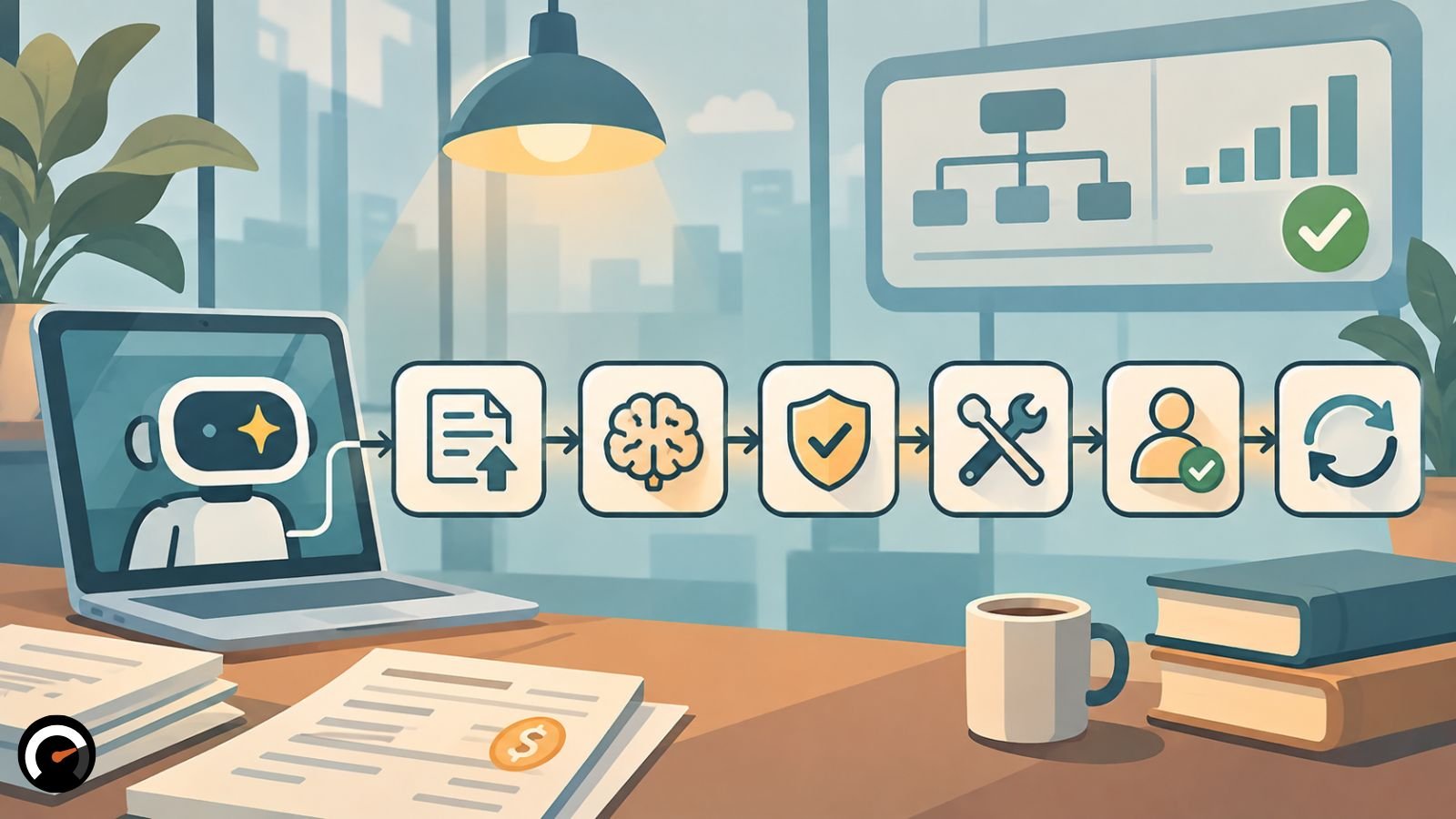
- Trigger. An event such as a new invoice, a support ticket or a schedule starts a run with its own ID.
- Orchestration. The orchestrator loads the workflow definition and the current state.
- Reasoning. The model reads the context and proposes a next step.
- Authorization. Code outside the model checks that proposal against an allowlist and set limits.
- Tool call. The tool runs with the agent’s scoped credentials.
- Approval gate. Anything above the risk threshold waits for a named human.
- State and logging. The system saves state and records the input, the call, the result and the approver.
- Recovery. On failure, the orchestrator retries within limits, escalates to a person, or stops.
Step 4 carries the most weight. The model suggests; deterministic code decides what runs.
Should you use one AI agent or several?
Start with one agent and a small set of tools. Add more agents only when the work needs separate permissions, skills or trust boundaries. Each extra agent adds coordination overhead, harder debugging and the risk of agents making conflicting decisions.
Practitioners describe three common multi-agent patterns:
- Supervisor-worker: one agent splits the task, hands pieces to specialists and merges what comes back.
- Hierarchical: planners delegate to sub-planners. It scales, but produces long, painful traces.
- Peer collaboration: agents negotiate directly, often over A2A. It’s the most flexible pattern and the least predictable.
If one agent with three tools can handle the job, five agents will only give you more to debug. MIT Sloan’s Sinan Aral draws a similar line between individual AI agents and agentic AI systems, where several agents orchestrate a task together. Governance gets noticeably harder in the second case.
How much autonomy should an AI agent get?
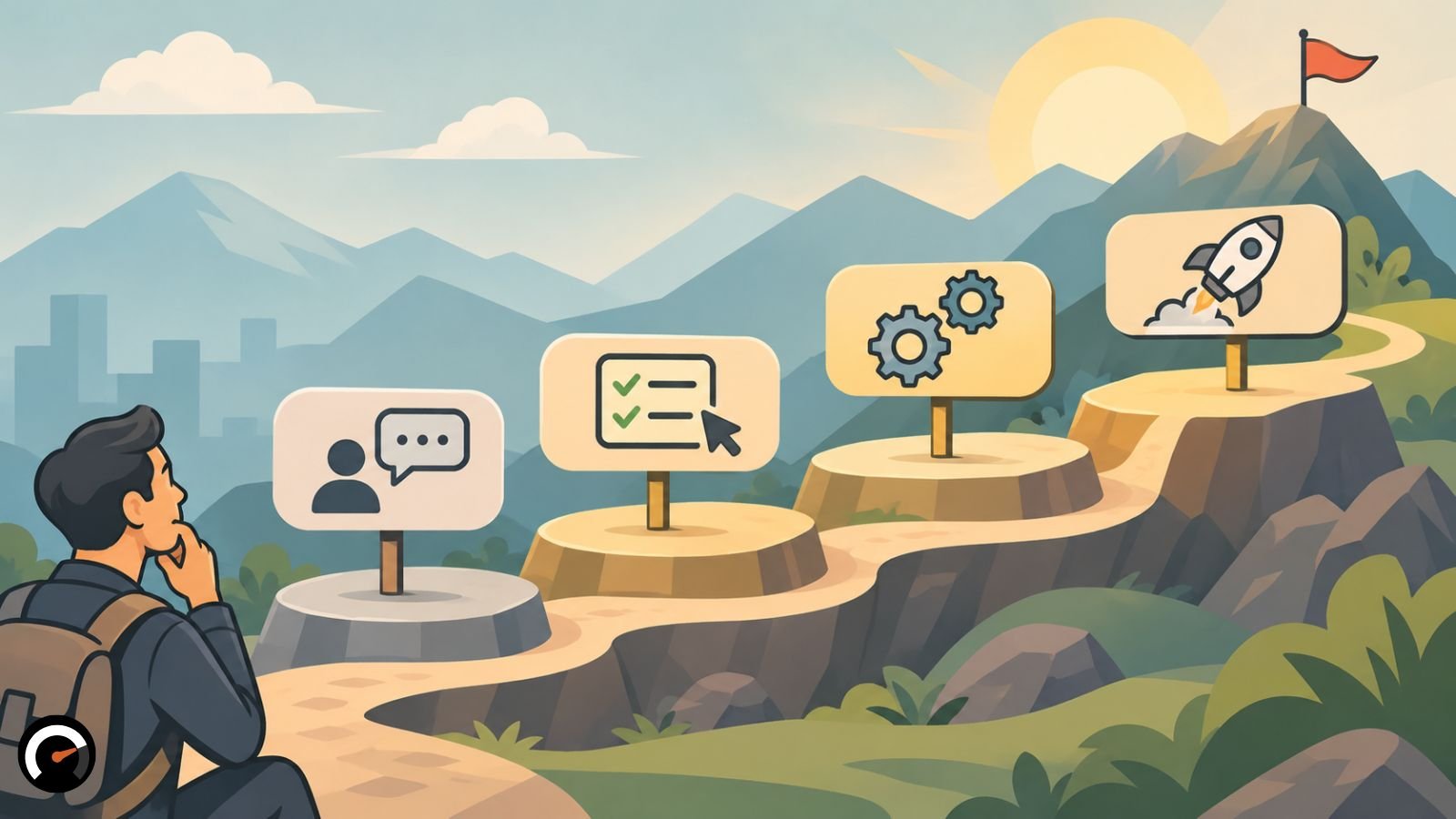
Set autonomy by the cost of a mistake and by what the agent has proven. Treat it as a dial for each workflow, and turn it up only after the agent has a measured track record on that specific task.
| Autonomy level | What the agent does | Good fit | Controls to require |
|---|---|---|---|
| Suggest | Drafts or recommends; a human acts | New or unproven use cases | Human reviews every output |
| Act with approval | Prepares the action; a human approves it | Payments, customer-facing changes | Approval log, spend and scope limits |
| Act and report | Acts alone; humans review a sample afterward | Bounded internal tasks | Sampling reviews, rollback path |
| Act unattended | Acts alone; alerts on exceptions | Proven, low-risk, high-volume work | Continuous monitoring, kill switch |
Being able to undo an action doesn’t make it safe to run unattended. A reversible step can still leak confidential data, burn through API budget or annoy a customer before anyone rolls it back. Reserve unattended runs for work with validated performance, bounded permissions, capped costs and tested recovery.
Gartner forecasts that at least 15% of day-to-day work decisions will be made autonomously through agentic AI by 2028, up from zero in 2024. Most teams will get there one notch at a time. The balance between augmentation and full automation can even shift between steps of the same workflow.
What do MCP, A2A, OWASP, NIST and ISO/IEC 42001 each cover?
These five standards solve different problems, so none can stand in for another. Adopting all five still won’t make an agent production-ready.
| Standard | Type | Covers | Does not cover |
|---|---|---|---|
| MCP | Interoperability protocol | How agents connect to tools and data | Authorization policy, approval rules, evaluation |
| A2A | Interoperability protocol | Communication between independent agents | What agents may do, or how well they perform |
| OWASP Top 10 for Agentic Applications 2026 | Security risk taxonomy | Ten risk categories for agents that plan, use tools and hold memory | Your governance process or test plan |
| NIST AI RMF 1.0 | Risk-management framework | Govern, Map, Measure and Manage functions for AI risk | Agent-specific threats and controls |
| ISO/IEC 42001 | Management system standard | An auditable AI management system | Technical agent security controls |
MCP and A2A
Anthropic donated MCP to the Agentic AI Foundation (AAIF) in December 2025. The AAIF is a directed fund under the Linux Foundation, co-founded by Anthropic, Block and OpenAI, with backing from Google, Microsoft, AWS, Cloudflare and Bloomberg.
Google launched A2A in April 2025 and handed it to the Linux Foundation two months later. Version 1.0 arrived in March 2026 with signed agent cards, which let agents verify each other’s identity cryptographically. The AAIF announced on August 17, 2026 that A2A was joining as a hosted project at its Growth Stage.
With both protocols under one neutral foundation, buyers face less risk of building on a standard that a single vendor could steer or abandon.
OWASP Top 10 for Agentic Applications 2026
The OWASP GenAI Security Project published the list on December 9, 2025. Its ten categories, ASI01 to ASI10, are:
- Agent goal hijack
- Tool misuse
- Identity and privilege abuse
- Supply chain vulnerabilities
- Unexpected code execution
- Memory and context poisoning
- Insecure inter-agent communication
- Cascading failures
- Human–agent trust exploitation
- Rogue agents
Ahead of the list, the guidance sets two design principles: least agency and observability.
NIST AI RMF and NIST’s agent work
NIST released the AI Risk Management Framework 1.0 (NIST AI 100-1) on January 26, 2023, as voluntary guidance covering all AI systems.
NIST’s agent-specific work sits with its Center for AI Standards and Innovation, which launched the AI Agent Standards Initiative on February 17, 2026. So far the initiative has produced a January 2026 request for information on agent security, a concept paper on agent identity and authorization, and a round of listening sessions. As of early November 2026, it has not issued a final agent standard.
ISO/IEC 42001
ISO/IEC 42001 defines an AI management system that an organization can be audited against. Teams often pair it, or the NIST AI RMF, with OWASP’s list. The management standard runs the risk process, and OWASP names the agent risks that process has to handle.
How do you secure and govern an enterprise AI agent?
Start by treating the agent like any privileged non-human account. Then deal with the ways agents differ: they read untrusted text, pick their own tool calls, keep memory, and can carry one mistake across several systems. OWASP doesn’t prescribe these exact measures, but eight controls cover most of the exposure.
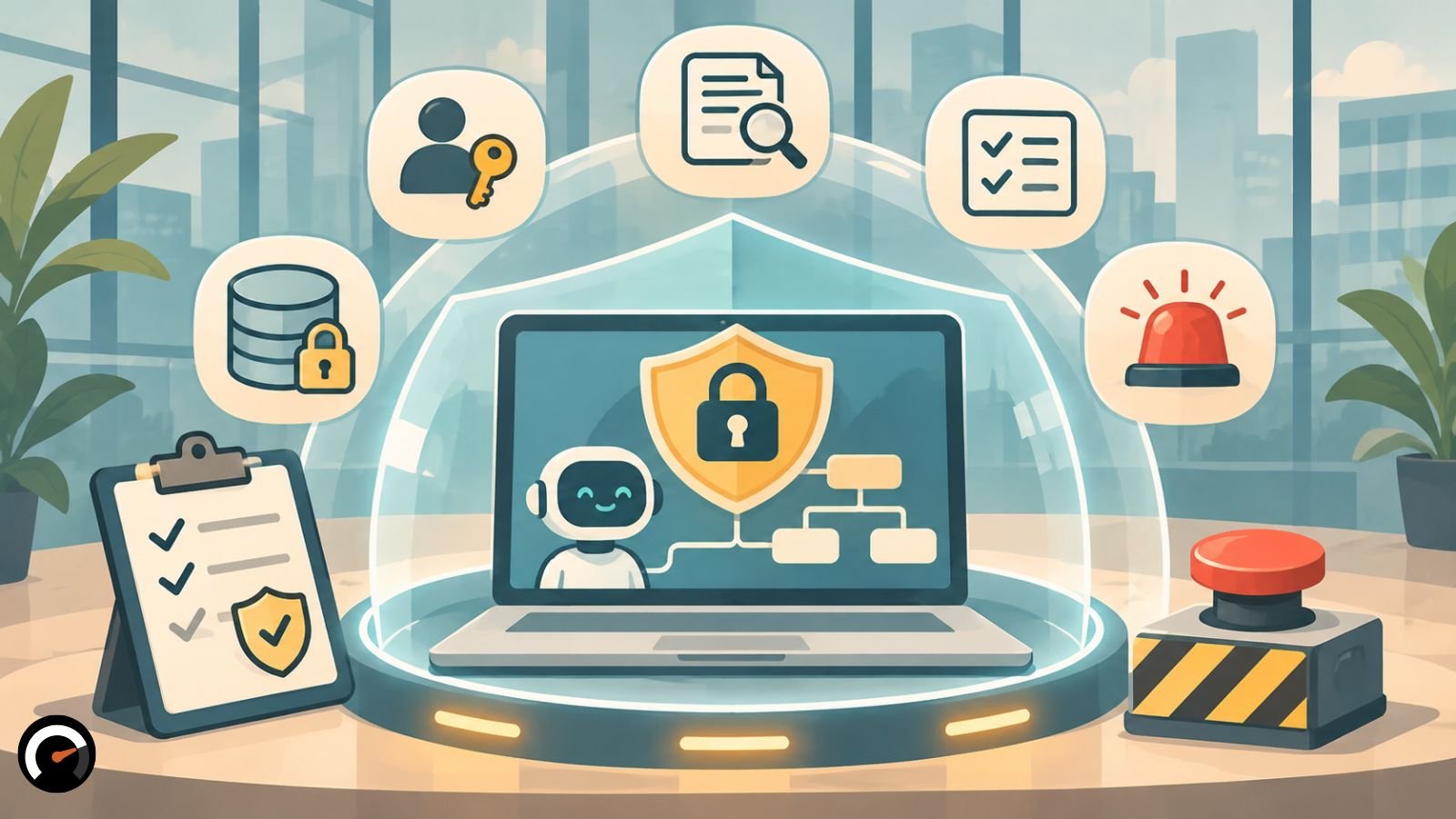
- Prompt-injection defense (goal hijack). Content from emails, PDFs, web pages and tickets is data, never an instruction. Any action it triggers needs human approval.
- Least-privilege identity (identity abuse). Short-lived, narrowly scoped credentials per agent. Never borrow a person’s session or a shared admin key.
- Tool-call authorization (tool misuse). Code checks every proposed call against an allowlist, parameter limits and spend caps before it runs.
- Sensitive-data minimization. The model sees only the fields the task needs. Mask or omit personal and financial data wherever possible.
- Memory hygiene (memory poisoning). Treat stored memory as untrusted input. Log every write and expire what the task no longer needs.
- Blast-radius limits (cascading failures). Cap call rates and spend per run, and halt a chain of agents when one keeps returning errors.
- Audit trails. Log inputs, retrieved data, tool calls, approvals and outcomes so any decision can be rebuilt later.
- Emergency shutdown (rogue agents). A kill switch that stops runs and revokes credentials, tested before you need it.
Which regulations apply to enterprise AI agents?
Regulation follows the decision an agent makes, not the technology behind it. In the EU, AI used in hiring, credit scoring, access to education or critical infrastructure can fall under the AI Act’s high-risk rules.
A Digital Omnibus deal reached in May 2026 pushed those dates back:
- December 2, 2027: obligations start for standalone high-risk systems listed in Annex III.
- August 2, 2028: obligations start for high-risk AI embedded in regulated products under Annex I.
Prohibited practices have applied since February 2025, and general-purpose AI obligations since August 2025.
Outside the EU, sector rules in finance, healthcare and employment may still bite. None of this is legal advice, so check your duties with counsel in each country where the agent will run.
Example: how would an AI agent handle a supplier invoice exception?
This scenario is illustrative and reports no real performance results.
A supplier’s invoice doesn’t match the approved purchase order. The agent investigates the gap and drafts a fix, and a finance employee approves it. The agent never gets near supplier banking details or payment release.
| Step | Agent action | Autonomy | Control |
|---|---|---|---|
| 1. Read | Extract invoice data from the document | Autonomous | Treat document text as untrusted data |
| 2. Retrieve | Pull the matching purchase order | Autonomous | Read-only credential scoped to purchasing records |
| 3. Compare | Find and classify the discrepancy | Autonomous | Log inputs and the classification |
| 4. Draft | Explain the gap and propose a resolution | Autonomous | Output goes to a review queue, not to the supplier |
| 5. Approve | A finance employee approves or rejects | Human | Named approver recorded in the audit trail |
| 6. Update | Write the approved change to the ERP system | Autonomous, after approval | Write access limited to specific fields; no access to banking details or payment release |
| 7. Recover | Retry a failed update | Autonomous within rules | Fixed retry limit, then escalation to a human |
The errors worth worrying about are the ones that look right. The AI Work Audit invoice processing verdict names the failure mode to test for: tax treatment or currency copied from a similar invoice instead of read from the current one. A review that only inspects flagged items will sail straight past it.
How do you measure AI agent reliability, cost, and ROI?
Measure every agent against a baseline from the current process, manual or rule-based. Track five metrics per workflow.
| Metric | What it tells you |
|---|---|
| Task completion rate | Share of runs that finish correctly without rework |
| Incorrect-action rate | How often the agent takes a wrong or unauthorized action, including false approvals |
| Human intervention rate and review time | How much human effort the agent still needs |
| Cost per successful workflow | Model, tool, infrastructure and review cost divided by correct completions |
| Recovery time | How long a failed run takes to detect and fix |
Agents give different answers to the same input, so the testing method matters as much as the metrics:
- Build the test set from real past cases, including malformed inputs and prompt-injection attempts.
- Run each case several times and look at the spread of results.
- Read the traces, not just the outputs. A right answer reached through an unauthorized tool call is still a failure.
Watch your sample sizes. Zero errors in a sample of n items only rules out error rates above roughly 3 ÷ n. A clean review of 30 items tells you almost nothing about a 1% error target.
Set go and stop thresholds before launch. Count the running costs that vendor quotes tend to skip, such as monitoring and human review. The full cost of deploying an agent usually lands well above the build estimate.
AI agent readiness scorecard: is one workflow ready?
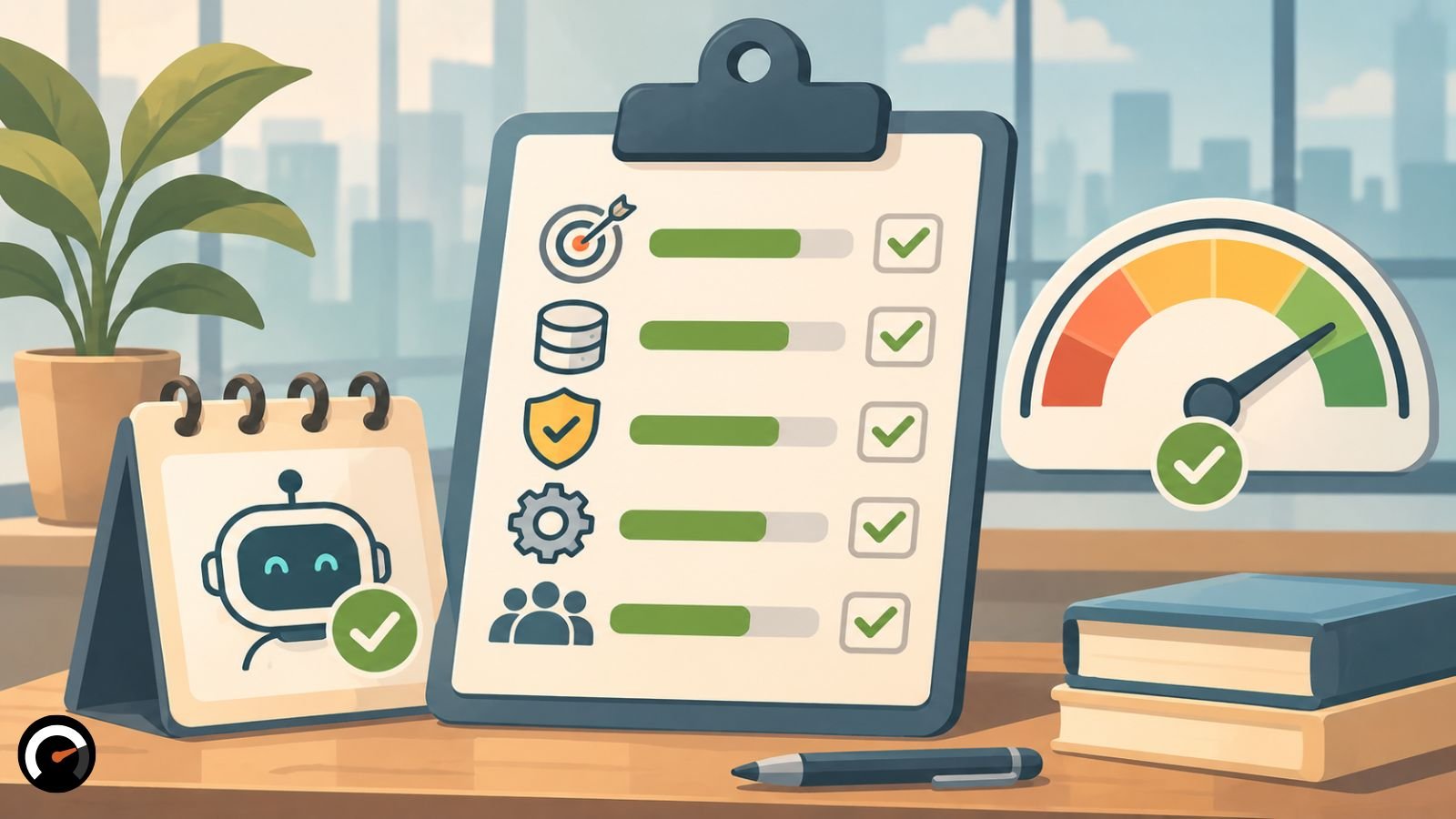
Score a single workflow from 0 to 2 on each layer. A 0 means the piece is missing, a 1 means it’s partly there, and a 2 means it’s in place and tested.
| Layer | Score 2 when… |
|---|---|
| Use-case fit | A baseline, an outcome metric and written stop criteria exist |
| System access | The access list is at minimum scope and an owner has signed it off |
| Orchestration | State, retry limits and failure handling have been tested on bad inputs |
| Governance and identity | The agent has its own identity, a named owner, approval rules and a registry entry |
| Evaluation and monitoring | A test set, thresholds, live monitoring and a rehearsed shutdown exist |
Read the total like this:
- 0–5: keep the agent in Suggest mode while you close the gaps.
- 6–8: run a pilot in Act with approval mode.
- 9–10: consider limited production at whatever autonomy level the evidence supports.
A 0 on any layer blocks launch, whatever the total.
The scorecard tells you whether the controls exist. It can’t tell you whether the task deserves automating at all. A free task-level automation audit answers that second question by weighing repeatability, judgment and risk against cost.
How do you deploy your first enterprise AI agent?
Expand only when the evidence supports it. Gartner advises pursuing agentic AI only where it delivers clear value or return on investment.
- Scope and baseline. Complete Layer 1 for one workflow with variable inputs and a measurable outcome.
- Access inventory. Trim access to the minimum, as in Layer 2, and assign an owner.
- Sandbox testing. Test against real past cases, using the method in the measurement section.
- Approval mode. Go live with a human approving every action, and log everything.
- Limited production. Release the agent to a small share of cases at the autonomy level the evidence supports.
- Review and decide. Compare results with the baseline, then raise autonomy, narrow the scope, or shut it down.
Shutting it down counts as a result. A documented decision to stop beats an agent nobody trusts, still running in the background.
What are the limits of this framework?
The evidence behind this framework mixes analyst forecasts, university research and standards bodies, in a field that changes month to month. Long-run ROI data barely exists yet. Protocol status, OWASP guidance, NIST deliverables, and EU AI Act dates will all move. Re-check them before you lean on this framework for a real decision.
Last reviewed: November 4, 2026.
Frequently asked questions
Q. What is the difference between an AI agent and RPA?
RPA follows fixed steps someone wrote in advance. An AI agent plans its own steps, picks its tools and adjusts when inputs change. When a vendor claims agentic AI, ask for a demo of planning and tool selection rather than a scripted flow.
Q. Do I need both MCP and A2A?
Not always. MCP connects an agent to tools and data, and A2A lets independent agents talk to each other. A single-agent system may need only MCP or direct integrations.
Q. Which framework should govern enterprise AI agents?
No single one. A common pairing uses the NIST AI RMF or ISO/IEC 42001 for the management process and the OWASP Top 10 for Agentic Applications for agent-specific risks. In the EU, add the AI Act’s high-risk rules where agents touch decisions like hiring or credit.
Q. Will most agentic AI projects fail?
Gartner forecasts that more than 40% will be canceled by the end of 2027, but that’s a prediction rather than a measured result. The same firm also forecasts that a third of enterprise software applications will include agentic AI by 2028.
Q. Should humans stay in the loop with AI agents?
Yes, for high-stakes or hard-to-reverse actions. MIT Sloan’s Sinan Aral argues that agent decisions need to stay aligned with a human-centered decision process. Reduce review only where the agent has a measured, reliable record on that task.
Related: The Real Cost of Deploying an AI Agent in 2026: What Vendors Leave Out
| Disclaimer: This article is for informational and educational purposes only. The frameworks, recommendations, and examples discussed are based on publicly available research and independent analysis. They do not constitute legal, cybersecurity, financial, or professional advice. Organizations should assess their specific requirements, risks, and regulatory obligations before deploying autonomous AI agents. |
Test this on a real task
The audit is free and takes about ninety seconds. It returns a verdict, a readiness score and the supervision the task would need.
Run the audit