
Nearly nine in ten organizations in McKinsey’s 2026 State of AI survey use AI regularly. Only 37 percent of respondents say it has added anything to EBIT (earnings before interest and taxes). Part of the explanation sits in two words people treat as one: AI and digitalization. When teams blur them, they tend to buy the tool first and find out later that the data or the workflow underneath can’t support it.
Digitalization is about changing how an organization works or earns money with digital technology. AI is one family of technologies that can push that change along, and it leans heavily on the groundwork digitalization leaves behind. Below you’ll find what each term means, where they depend on each other, why adoption surveys can’t agree, how to decide what to fix first, and the problems that tend to stall projects.
Last updated: November 8, 2026
What is the difference between AI and digitalization?
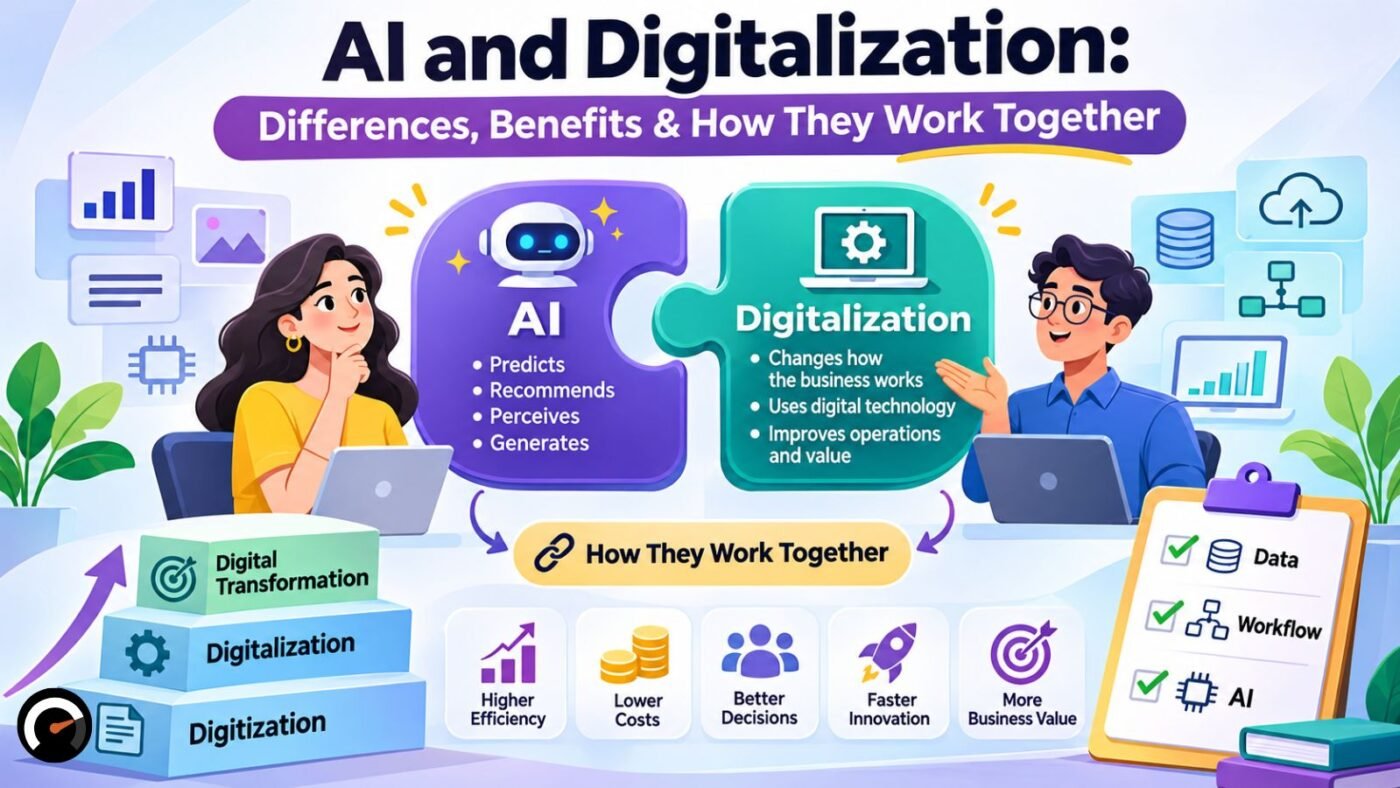
Digitalization is the use of digital technology to change how an organization operates or makes money. AI covers technologies that predict, recommend, perceive, or generate content. Digitalization describes something happening to the organization. AI describes a type of tool that can help make it happen.
How strictly you define digitalization depends on whom you ask. Gartner’s glossary, as SAP quotes it, takes the narrow view: using digital technologies to change a business model and create new revenue and value, which amounts to becoming a digital business. Most people use the word more loosely, for any change to how operations run, and some of Gartner’s own writing does too.
Three related terms tend to get stacked into a ladder. Digitization converts information from analog to digital form. Digitalization puts that information to work in changing how the business runs. Digital transformation usually refers to the organization-wide shift that all those changes add up to. A 2021 Journal of Business Research review by Verhoef and colleagues draws the same three-stage line, though in everyday conversation the stages run together.
The ladder is a model, not a maturity path. Real organizations skip rungs, go back to earlier ones, and sit on different rungs for different processes. Scanning an invoice is digitization. Rethinking how the company buys, approves, and pays, to the point where suppliers deal with it differently, is digitalization.
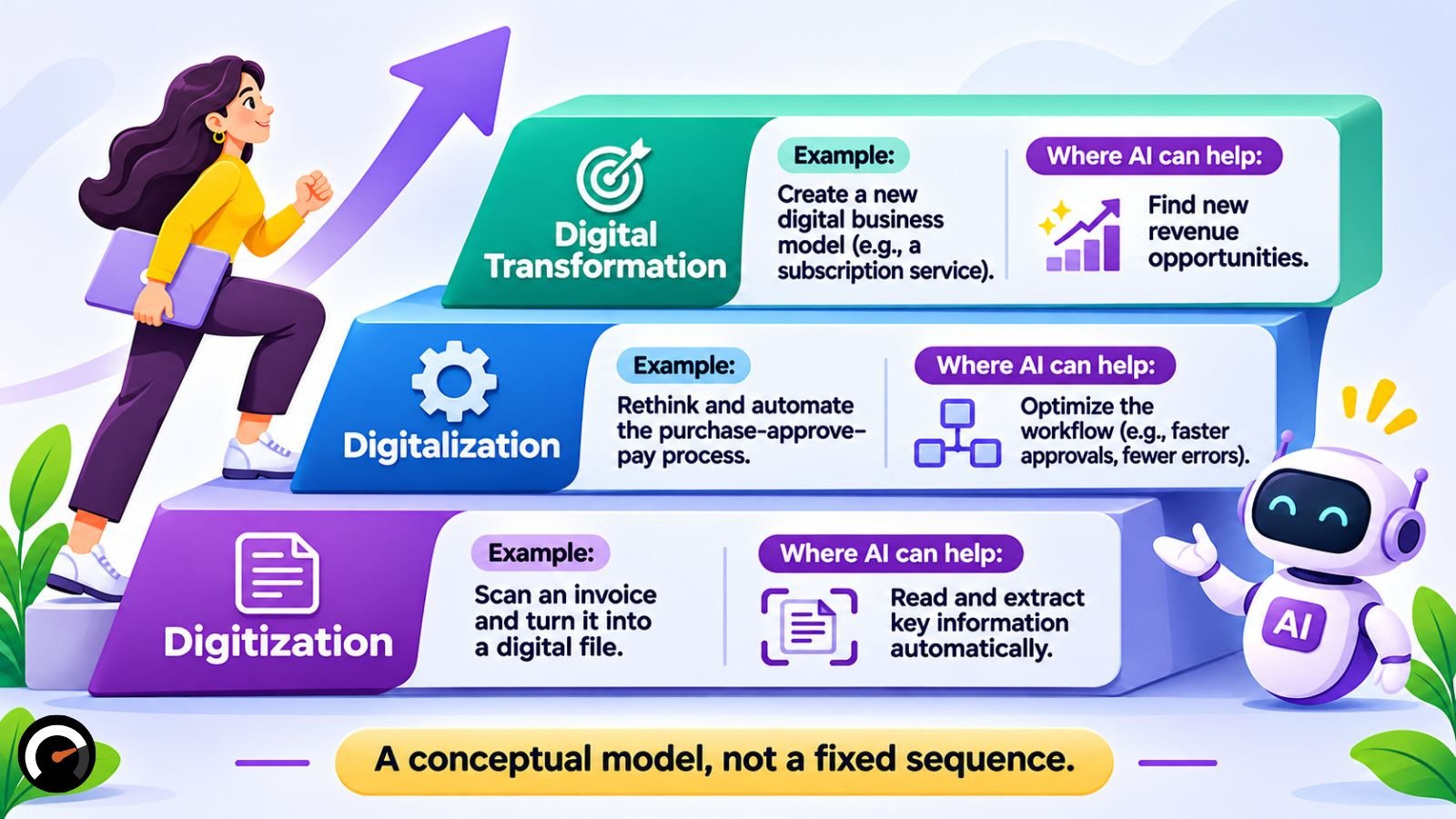
AI turns up on every rung, which goes a long way toward explaining the confusion. Near the bottom, document-processing tools split stacks of scans into separate files on their own. Further up, companies use AI to optimize operations. AI operates inside digitalization. It doesn’t replace the concept.
Where do AI and digitalization depend on each other?
AI needs data that fits the task you give it. The more systems a task touches, the more groundwork that takes. AI can also speed up parts of digitalization, reading paper records for instance. Where teams go wrong is assuming the speed-up means they can skip the groundwork.
Gartner has the strongest evidence here. In a February 2025 release, it reported that 63 percent of organizations either lack the right data management practices for AI or aren’t sure whether they have them. That came from a July 2024 survey of data management leaders. In the same release, Gartner predicted that through 2026, organizations will abandon 60 percent of AI projects that lack AI-ready data.
Read those two numbers differently. The 63 percent is something people reported in a survey. The 60 percent is a forecast, and it only covers projects without AI-ready data. The forecast window closes at the end of this year, and nobody has published a measured outcome yet.
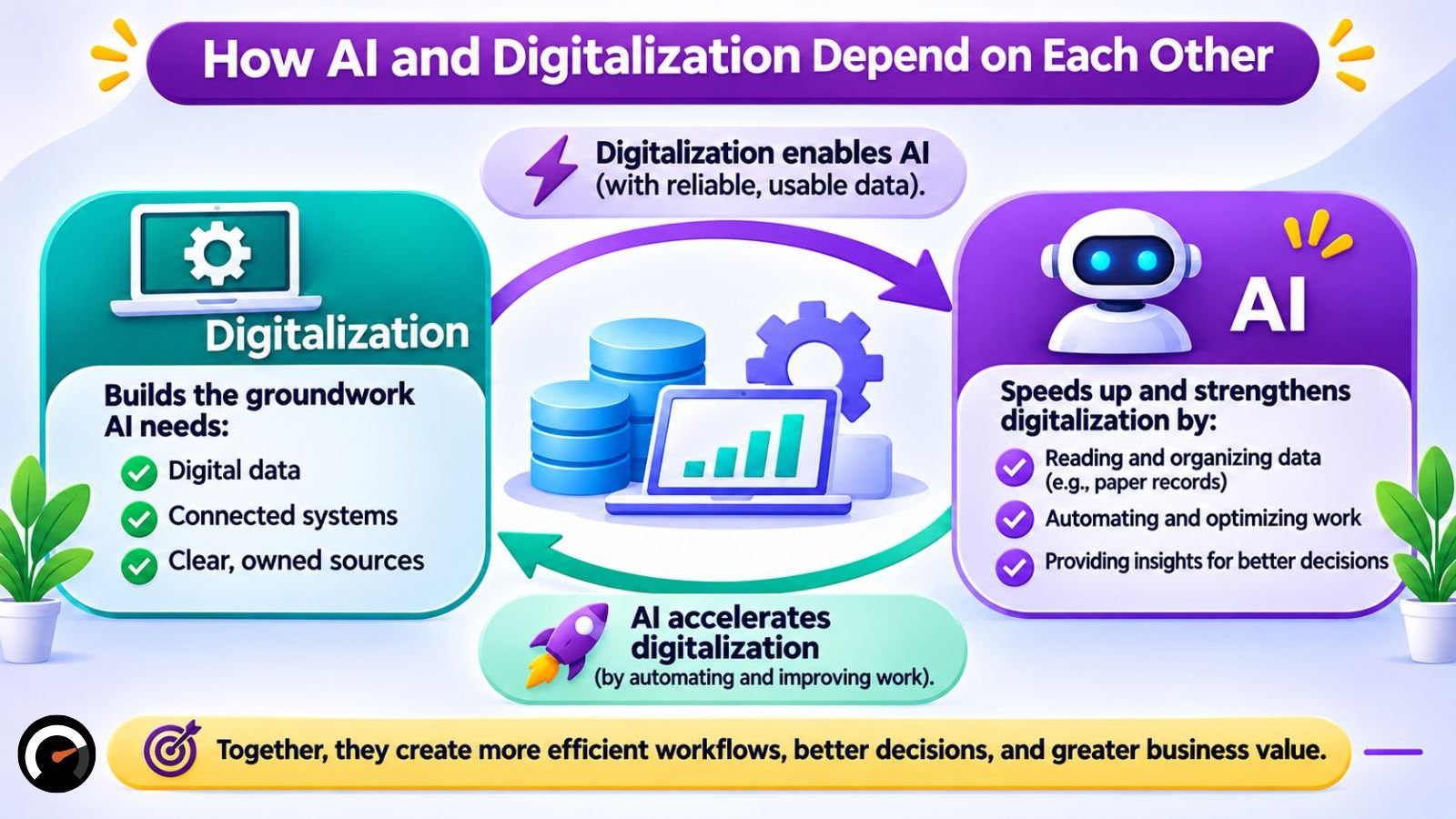
The underlying causes are dull ones. Traditional data management tends to leave information scattered in silos across repositories and platforms, with little record of how it’s used. A model can read all of it. What it can’t do is tell you which copy is correct. Teams building agents on company documents get around this by giving each source a named owner and ranking sources by authority, so when two versions conflict, one wins. Ranking sources comes early when you build a knowledge base for AI agents.
Some vendors argue you can run digitalization and AI side by side and skip the sequencing. For a narrow job, they have a point. A team can aim a model at a clean set of documents without touching its core systems. That approach usually breaks once it reaches production, where answers depend on data spread across systems that don’t agree.
Why do surveys disagree so much about AI adoption?
McKinsey says nearly nine in ten respondents’ organizations use AI regularly. The U.S. Census Bureau measured 17 to 20 percent of American businesses between December 2025 and May 2026. By early October 2026 the figure had climbed to roughly 24 percent, according to a tracker of the biweekly Census releases. Most of that difference comes from who’s being asked, what counts as “use,” and how big the firms are.
Start with the respondents. McKinsey’s survey ran from May 4 to June 8, 2026, with 1,719 participants across 97 countries, weighted by each country’s share of global GDP. About a third of them (595) work at organizations with $1 billion or more in revenue. The Census sample includes businesses with fewer than five employees, so it was always going to look different. In the Census data, AI use rose among firms with at least 20 employees and barely moved among smaller ones.
Then there’s the wording. On November 17, 2025, the Census Bureau broadened its core question to cover AI use in any business function. Numbers jumped enough that before-and-after comparisons stopped making sense. The bureau changed the wording again starting with its October 19, 2026 collection, so the series is about to break a second time.
Neither survey tells you whether AI is paying off. McKinsey does track that separately, but each measure uses its own base, so they can’t be read as steps in a single funnel.
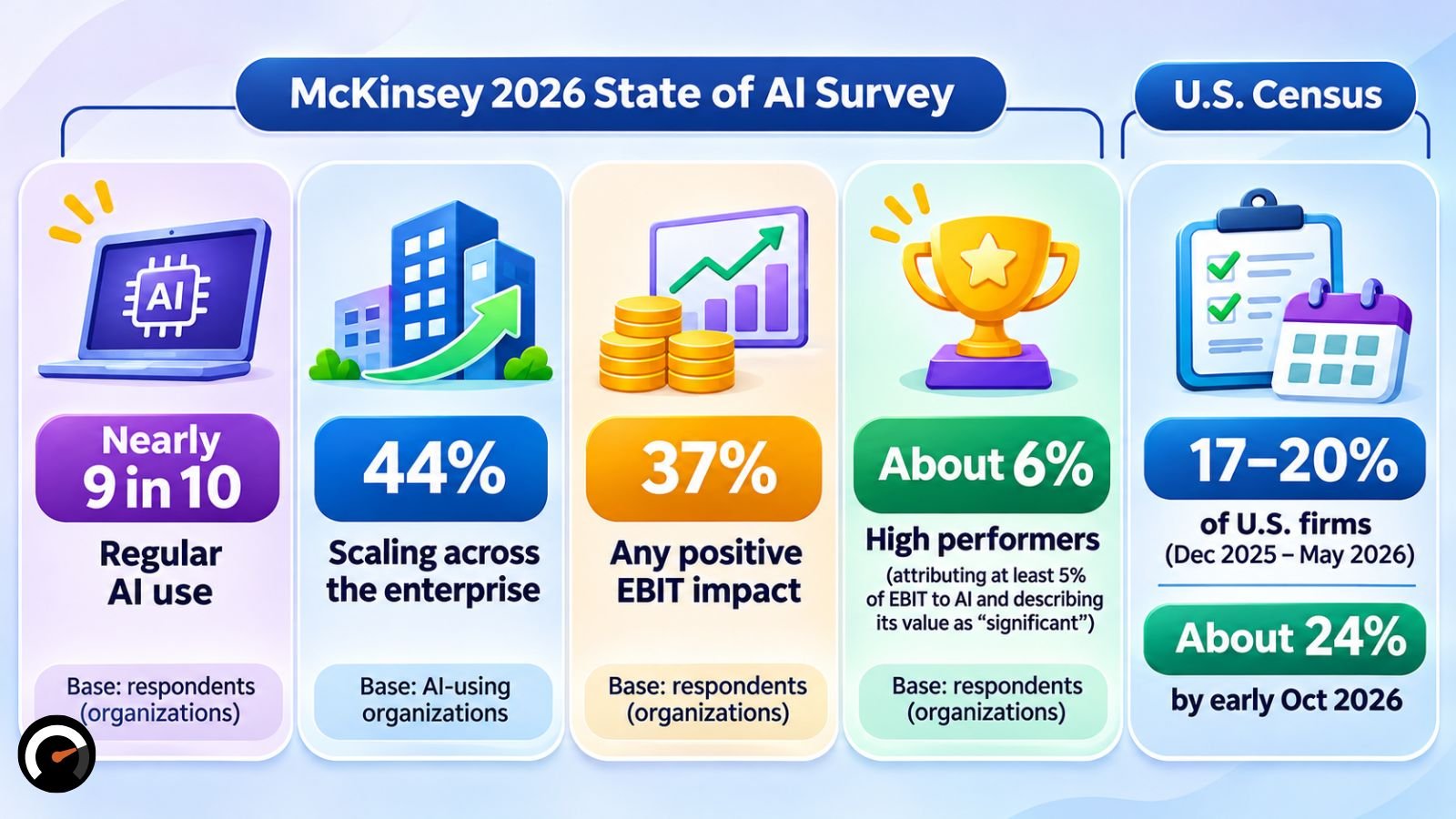
Eighty percent of McKinsey respondents say AI has made them personally more productive. The share reporting any EBIT impact hardly changed from the year before. Academic studies show a similar split. Controlled experiments on single tasks usually report bigger gains than studies that follow whole workforces, as research on knowledge work automation shows.
McKinsey’s high performers stand out in one respect. Nearly three-quarters say they fundamentally redesigned workflows because of AI. Among everyone else, it’s about a quarter. Keep in mind this is a correlation in survey answers. Companies that already see returns may simply be more willing to redesign. Reworking how the job gets done is closer in spirit to digitalization than adding a chatbot. It still falls short of digitalization in Gartner’s stricter business-model sense.
What should you fix first: the data, the workflow, or the AI?
If a workflow’s data lives on paper, in scattered files, or in systems that contradict each other, fix the data first. If it’s already digital, consistent, and someone owns it, you can pilot AI. Most organizations end up doing both at the same time, just on different workflows.
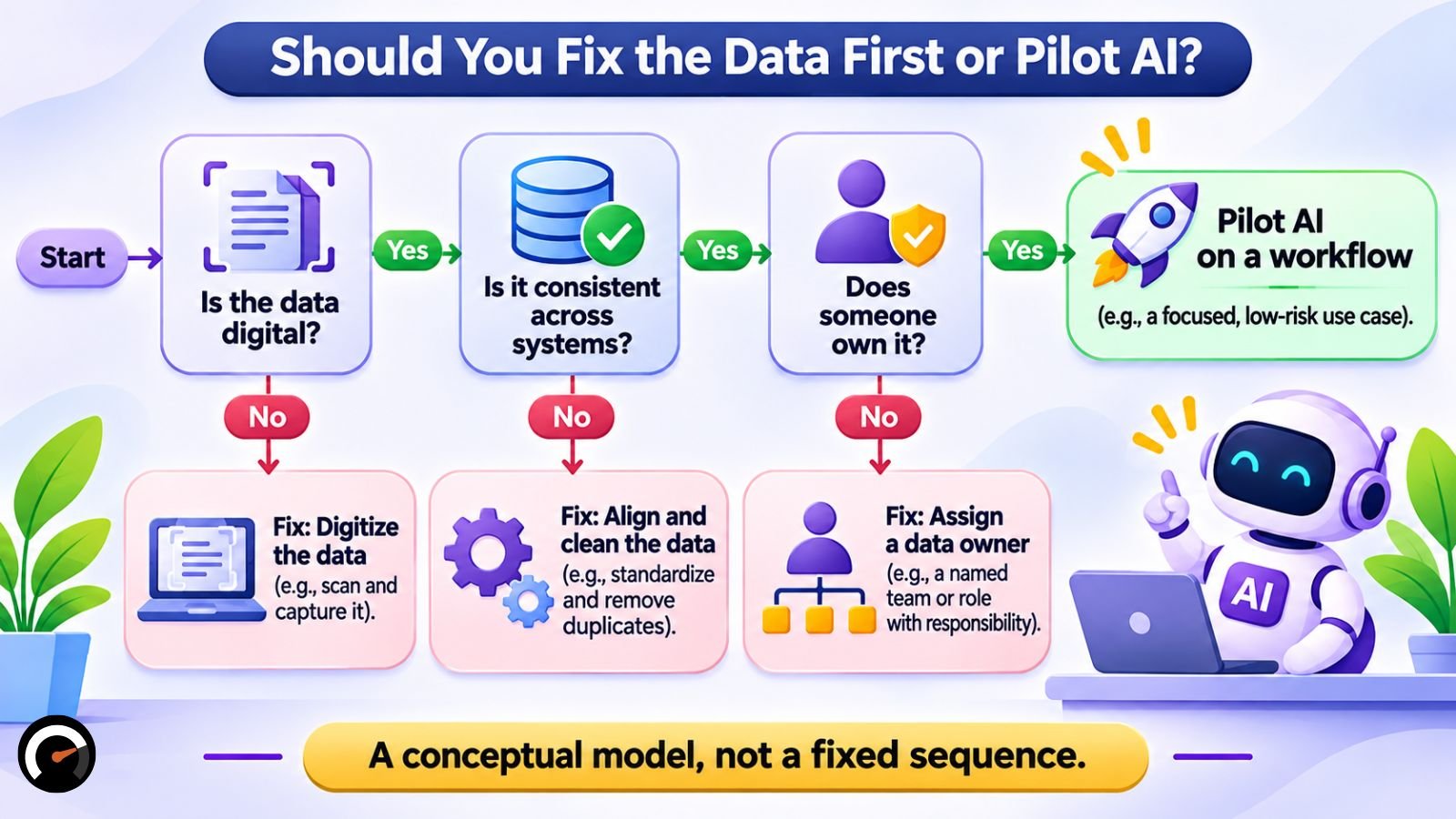
The table below is a working framework drawn from the sources in this article. It isn’t a published standard.
| What the workflow looks like today | Start with | What to watch |
|---|---|---|
| Records on paper or scanned PDFs | Digitization, where AI document reading can speed things up | Extraction errors become downstream errors, so spot-check |
| Digital, but split across tools that disagree | Integration and shared definitions | Silos and undocumented data use |
| Digital, consistent, with a clear owner | A narrow AI pilot | Define success in money terms before you start |
| AI already running, no financial result | Redesign the workflow around it | Whether anyone measures impact |
Here’s a hypothetical to make it concrete (it isn’t a real case). A distributor keeps price lists in spreadsheets that get emailed around, and it wants an AI assistant to draft quotes. The assistant would copy whichever spreadsheet it happened to find. Before any pilot, the company needs one maintained price list.
You don’t need AI for every step, either. Where a step follows fixed rules, ordinary rule-based automation usually does the job. AI makes sense where a step involves reading language, images, or context.
On the table’s last row, McKinsey adds one more finding. High performers are roughly twice as likely to say senior leaders visibly back their AI work and that they have set processes for measuring results.
What goes wrong when organizations combine the two?
The usual pattern is that tools arrive before anyone has sorted out the data or who owns it. Running costs come in higher than planned, and the people using the tools every day feel the strain. Those problems existed before AI. Usage-based pricing and unpredictable outputs just make them harder to hide. Most of the figures below come from McKinsey’s 2026 survey.
Cost is the first surprise. About one in five respondents say AI operating costs, token costs included, have held back their organization’s AI use, even though most plan to raise AI investment. A worked first-year AI agent budget found that the largest running cost was the people handling escalations, not model usage, though its figures rest on the author’s stated assumptions.
The strain also falls unevenly. Forty-seven percent of midlevel managers and individual contributors report at least one negative effect of AI on their work. Among executives and senior managers, it’s 31 percent.
Expectations ran ahead of reality, too. Fourteen percent of respondents say AI contributed to a workforce decline over the past year. A year earlier, 32 percent had predicted one.
If you build or deploy AI for EU users, regulation belongs on the list. Regulation (EU) 2026/1744 took effect on July 27, 2026. It pushed high-risk obligations back to December 2, 2027 for Annex III systems and August 2, 2028 for Annex I systems. The rest of the AI Act kept its own schedule. Transparency duties have applied since August 2, 2026, and two new prohibitions start on December 2, 2026.
Is AI changing what digitalization means?
Maybe, around the edges. In a 2026 chapter posted on arXiv, TU Berlin’s Ina Schieferdecker argues that agentic AI makes digitalization recursive. Her claim is that digital systems are starting to build and change the very software that runs digital processes. She calls it a fourth phase, “digital self-transformation,” coming after digitization, process digitalization, and digital transformation. It’s a theoretical argument, and she doesn’t present data for it.
McKinsey’s numbers offer one early hint in the same direction. Thirty-two percent of respondents say their organization skipped buying at least one software product or feature because it could build the same thing in-house with agentic coding tools. That’s self-reported, and it skews toward bigger firms. About two in ten respondents’ organizations are scaling coding agents, compared with 31 percent at larger enterprises.
Conclusion
Digitalization changes how a business runs. AI is one of the tools that runs on the data and workflows that change leaves behind. Most organizations already have AI in place. The handful seeing real returns are more likely to have rebuilt the work around it. Gartner’s warning about data comes at the same lesson from the other direction.
The next step can be modest. Choose one workflow, write down where its data lives, and note which parts are digital, consistent, and owned by someone. That list will tell you whether to try AI now or fix the foundations first. After that, a free task automation audit can score whether the task is worth automating at all.
FAQs
Q. What is the difference between digitization and digitalization?
Digitization turns analog information into digital form, like scanning a paper form into a PDF. Digitalization uses digital technology to change how a business operates or earns revenue. The first changes the format. The second changes what the organization does with it.
Q. Do you need digitalization before using AI?
Not across the board. You can trial AI on one clean, digital workflow while other processes stay on paper. The part you can’t skip is having the right data for that particular task, so check it before you pick a tool.
Q. Is digital transformation the same as digitalization?
Close, but not quite, and sources often mix them up. Digitalization usually refers to changing a process or business model with digital technology. Digital transformation is the larger, organization-wide change those shifts produce. When two sources disagree, check which definition each is using.
Q. Is AI transformation different from digital transformation?
Some practitioners say yes. Traditional digital systems give the same output every time, while AI outputs vary and need ongoing monitoring. That’s a practitioner’s view rather than an agreed definition. In practice the two overlap heavily, since AI projects build on the data and workflows earlier digital work created.
Q. Which is correct, digitalization or digitalisation?
Both. Digitalization is the American spelling and digitalisation the British one, with no difference in meaning. Choose the one your audience expects and use it throughout, because switching between them looks like a mistake.
Related: Agentive AI vs Agentic AI: What’s the Real Difference?
| Disclaimer: This article is for informational and educational purposes only. The statistics, research findings, and industry forecasts are based on publicly available sources at the time of writing and may change over time. Survey results reflect different methodologies, sample sizes, and definitions and should not be interpreted as directly comparable. Any examples or frameworks provided are illustrative and do not guarantee specific business outcomes. Readers should independently evaluate their organization’s needs before making AI adoption or digitalization decisions. |
Test this on a real task
The audit is free and takes about ninety seconds. It returns a verdict, a readiness score and the supervision the task would need.
Run the audit